
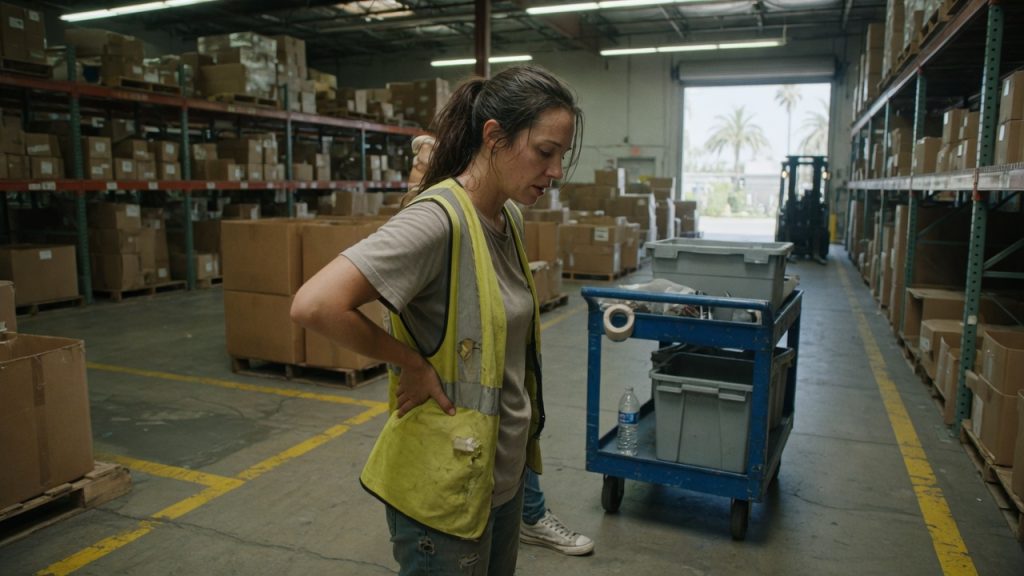
Yes. If you got hurt while working for Amazon in California, you can usually receive workers’ compensation. That includes medical care and a portion of your lost wages, even if the injury was an accident and nobody did anything “wrong.” Full-time associates, part-time associates, seasonal hires, and many temps are covered. You do not have to prove Amazon was at fault. You do have to report the injury, get medical care, and file the claim on time. Independent contractors (including some Flex drivers) follow different rules, which we cover below.
If you are reading this with ice on your back and a knot in your stomach, you are in the right place. Warehouse work in California is hard on a body. The pace is real. And no, you are not “being dramatic” because your shoulder started barking three months in.
Laguna Law Firm has spent more than 20 years helping injured workers across California. For a straight answer, call (949) 930-1386 or visit lagunalawfirm.com. The consultation is free.
The short version of how this works
California’s workers’ compensation system is no-fault. That is a fancy way of saying the insurance company is supposed to pay for work injuries without a courtroom fight over who caused them. In exchange, you generally cannot sue your employer for pain and suffering the way you might after a car crash.
Amazon is required to carry this coverage. In practice, claims are often handled by a third-party administrator. The name on the letterhead does not change your rights. You still have a claim against the policy that covers the job.
You can be hurt in one ugly moment, like a fall off a step stool. You can also be hurt slowly. California treats both as work injuries. A herniated disc from years of stowing and picking is still a work injury. So is carpal tunnel from scanning thousands of items a day. Those slower injuries are called cumulative trauma, and they are some of the most common claims we see from fulfillment centers.
Who is actually covered?
Most people clocking in at a California fulfillment center, sortation center, or delivery station are employees. Employees are covered from day one. It does not matter if you are seasonal, part-time, or “just helping through Prime week.”
A few situations get messy:
You work through a staffing agency. Plenty of warehouse workers are hired by a temp company and sent to an Amazon site. In California, that often creates dual employment. Do not assume you have no claim because your paycheck has a different company name on it.
You drive for a Delivery Service Partner (DSP). Many “Amazon drivers” are employees of a small delivery company that wears Amazon colors. If you are a W-2 employee of that DSP, you typically file against the DSP’s workers’ compensation policy, not a personal auto policy. Those claims are still California workers’ compensation claims.
You drive Amazon Flex. Flex drivers are generally treated as independent contractors. Traditional workers’ compensation may not apply the same way. California’s Proposition 22 requires certain gig platforms to carry occupational accident coverage while you are on an active block. That is not identical to workers’ compensation. If you were hurt during a Flex block, talk to a lawyer before you assume you have nothing.
Your immigration status. California workers’ compensation does not require U.S. citizenship. If you were working and you got hurt, you can still have a claim.
If you are not sure which bucket you fall into, that is normal. Bring your pay stubs and we will sort it out.
What kinds of Amazon job injuries actually qualify?
Almost any injury that arises out of the job and happens in the course of the job. In warehouse English, that means:
- Back, neck, and shoulder injuries from lifting, twisting, and reaching into totes
- Knee and ankle injuries from concrete floors, ladders, and long shifts on your feet
- Wrist, elbow, and hand problems from scanning, taping, and repetitive motion
- Slips, trips, and falls in the aisle, on the dock, or in the parking lot on the way to your car after a shift
- Being struck by a pallet jack, cart, or falling freight
- Heat illness in a building that feels like an oven in July
- Crush injuries, fractures, and cuts from equipment
- Stress injuries in limited situations (California has extra rules for psychiatric claims)
A lot of people wait because the first day was “just sore.” Then the soreness becomes a limp. Then someone at AmCare says it is a strain and you will be fine. Maybe you will. Maybe you will not. The claim clock does not care that you tried to tough it out.
If a supervisor told you to keep working after you reported pain, write down the date, the name, and what they said.
The Amazon-specific wrinkle: AmCare, quotas, and feeling rushed
Many Amazon sites have an on-site clinic, often called AmCare. It can be useful for first aid. It is not a substitute for a full medical evaluation, and it is not your workers’ compensation claim.
Go there if you need ice or a bandage. Still tell your manager. Still ask for a workers’ compensation claim form (in California that is the DWC-1). Still see a doctor who can actually diagnose a disc, a tear, or a nerve problem.
California also has a warehouse quota law, Assembly Bill 701. Covered warehouses have to disclose productivity quotas in writing. Quotas cannot be used in a way that stops you from taking rest breaks or using the bathroom. If you got hurt because you were pushing rate, that does not kill your claim. If anything, it helps explain how a “routine” shift turned into a medical file.
You do not need to prove the quota was illegal to get workers’ compensation. The quota conversation is extra context, especially if the company later argues you were “unsafe.”
What workers’ compensation actually pays
This is the part people Google at 1 a.m.
Medical treatment. Doctor visits, imaging, physical therapy, surgery, prescriptions, and mileage to appointments. You should not be paying out of pocket for authorized care related to the work injury.
Temporary disability (TD). If you cannot work, or you can only work reduced hours, you may get wage replacement. In California that is generally two-thirds of your average weekly wage, subject to state minimums and maximums. There is usually a short waiting period (often three days) unless you are hospitalized or off long enough for it to be waived.
Permanent disability (PD). If the injury leaves you with lasting limits, you may receive a permanent disability award based on a medical rating. This is not a lottery ticket. It is a calculation. A good lawyer makes sure the rating actually matches what you cannot do anymore.
Supplemental Job Displacement Benefit. If you cannot go back to your old job and the employer does not offer qualifying alternative work, you may get a voucher for retraining. In many cases that voucher is up to $6,000.
Death benefits. If a worker dies from a work injury, dependents may have a claim.
Notice what is not on that list: a big pain-and-suffering check from Amazon itself. That is the trade-off of the no-fault system. There are exceptions, like a third-party case if a defective machine made by another company hurt you. Those are fact-specific.
What to do in the first 48 hours
Treat this like a checklist, not a lecture.
- Get medical care. Emergency room if it is bad. Urgent care or your own doctor if it is not an ambulance situation. Tell the provider it happened at work.
- Tell your supervisor the same day if you can. “I hurt my back stowing on line 4 around 2 p.m.” is better than “my back hurts.”
- Ask for the DWC-1 claim form. Fill it out. Keep a copy. Your employer is supposed to give you this form.
- Write down witnesses, the exact task, the time, and whether you had already complained about the same body part.
- Save texts, A to Z app screenshots, rate reports, and photos of the area if it is safe to take them.
- Be careful with recorded statements to the insurance adjuster. You can be polite and still say you want to talk to a lawyer first.
A small delay is not the end of the world. A month of “I’ll see if it gets better” can become a fight about whether it even happened at work.
Deadlines you cannot shrug off
In California you should report the injury to your employer within 30 days. You generally have one year from the date of injury to file an application with the Workers’ Compensation Appeals Board if the claim is disputed. Cumulative trauma claims can use the last date of injurious exposure, which is often your last day doing the job that hurt you.
The safe move is to treat 30 days as a hard personal deadline, not a suggestion.
If the insurance company sends a denial letter, do not throw it in a drawer. Denials are common. They are not the final word. Laguna Law Firm challenges them every week.
“They said I can get fired if I file”
California law makes it illegal for an employer to fire you, cut your hours, or punish you for filing a workers’ compensation claim. Retaliation still happens. If your assignment disappears the week after you report an injury, that is worth a conversation with a lawyer, and it may be a separate claim.
You also cannot be forced to use your own health insurance for a work injury, and you should not have to burn PTO as a substitute for temporary disability if you qualify for TD.
Why these claims stall (and how they get unstuck)
Amazon is huge. The claims process is a machine. Machines are good at saying no on a template.
Typical snags:
- The clinic called it “non-industrial” after a 10-minute visit
- The adjuster says there is no specific incident
- Light duty was offered, then taken away
- You were sent back to work with restrictions nobody on the floor can honor
- Only one body part was accepted, even though your neck and your arm are clearly connected
- Surveillance got a clip of you grocery shopping and the carrier decided you are fine
None of that means you invented the injury. It means you need someone who knows how to push a file through the Division of Workers’ Compensation, request the right medical reporting, and, when needed, take the case to a hearing.
A workers’ compensation attorney in California is typically paid on a contingency fee set by the Workers’ Compensation Appeals Board. You do not write a big retainer check to get started. If there is no recovery, the attorney fee generally is not owed. We will explain the fee in plain English on the first call.
A note on “I feel bad filing”
You showed up. You hit rate. You worked the extra overtime. Filing a claim is not a betrayal of the team. It is how the system is supposed to pay for the medical bill when the job uses up a shoulder.
Insurance companies budget for this. Your rent does not.
How Laguna Law Firm helps injured Amazon workers
We are a California workers’ compensation firm. That is the work. We help people in warehouses, on trucks, in offices, and on job sites get medical care authorized and benefits paid.
What that looks like in real life:
- We review what you have already told Amazon and the clinic
- We make sure the DWC-1 and the application are done correctly
- We fight over treatment delays, QME exams, and stingy disability ratings
- We negotiate settlements when a settlement makes sense, and we try cases when it does not
- We keep you posted, because sitting in the dark is its own kind of injury
Call (949) 930-1386. Or go to lagunalawfirm.com and send a note. Virtual consults are available. Bring what you have.
Frequently asked questions
Do I still qualify if I had a bad back before I started?
Maybe, yes. A job that makes an old problem worse can still support a claim. Do not let a clinic shrug and say “that’s just age.”
What if I was written up for rate the same week I got hurt?
Report the injury anyway. Discipline and a workers’ compensation claim are not the same conversation. Mixing them up is how people talk themselves out of medical care.
Can I pick my own doctor?
It depends on whether Amazon has a valid Medical Provider Network and where you are in the process. You have more choice than a lot of workers are told on day one. Ask before you sign a stack of papers in the break room.
Will this affect my immigration case or my green card?
Workers’ compensation is a benefit for an injury, not a public charge trap in the way people fear. If you have a specific immigration concern, tell us so we can be careful with how information is shared.
What if I already settled and I am still in pain?
Some settlements close everything. Some do not. Bring the paperwork. Guessing from memory is how people miss a window.
Bottom line
An Amazon worker in California can receive workers’ compensation for a job injury. The building can be a fulfillment center in the Inland Empire, a delivery station in Orange County, or a sort center in the Central Valley. The injury can be a fall or a slow grind. The claim can still be real.
The hard part is not the legal theory. The hard part is the paperwork, the delays, and the feeling that a giant company has a giant head start. That is the part we handle.
Laguna Law Firm
Phone: (949) 930-1386
Web: lagunalawfirm.com
Free case review. You talk, we listen, then we tell you what we think. No pressure routine, no mystery bill.