
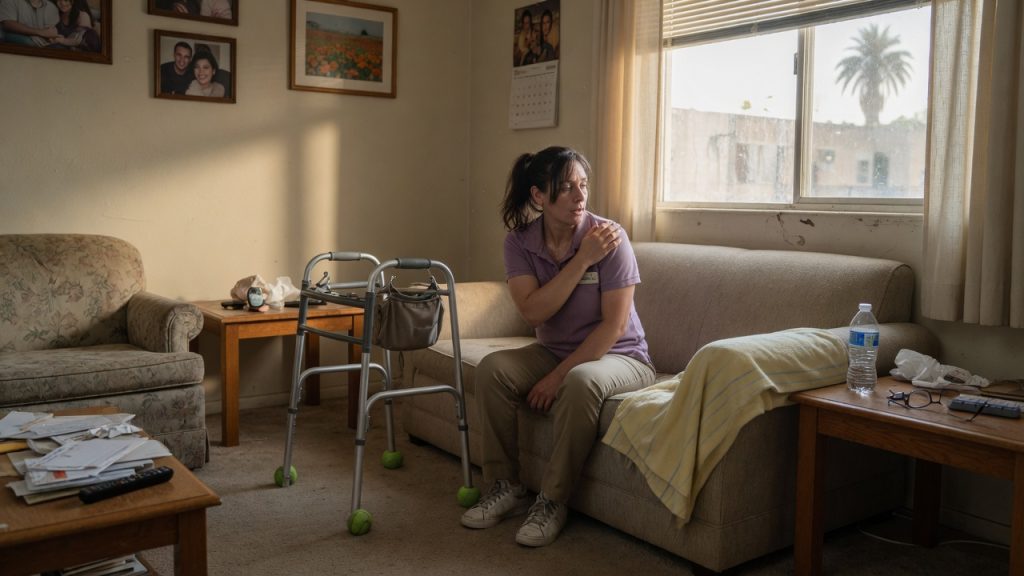
Yes. If you got hurt taking care of someone in a California home, you can often receive workers’ compensation. That includes medical care and a portion of your lost wages, even if the transfer, the slip, or the bad lift was an accident. Home health agency employees are covered the way other employees are. In-Home Supportive Services (IHSS) providers have state workers’ compensation coverage too, even though the person you care for hires you and directs the day. A family that hires a regular caregiver can also be an employer under the Labor Code. You do not have to prove anyone was careless. You do have to report the injury, get medical care, and file on time.
People get hurt helping someone to the bathroom and then talk themselves out of a claim because it happened in a house.
Laguna Law Firm has spent more than 20 years helping injured workers across California. For a straight answer, call (949) 930-1386 or visit lagunalawfirm.com. The consultation is free.
The short version of how this works
California’s workers’ compensation system is no-fault. The insurance company, or the state’s IHSS program, is supposed to pay for a work injury without a fight over who lost their balance. In exchange, you generally cannot sue your employer for pain and suffering the way you might after a car crash.
You can be hurt in one moment. A transfer goes wrong. A bathroom floor is wet. A client grabs your arm on the way down. You can also be hurt slowly. Shoulders and backs wear out from the same lift, every day, for years. California treats that cumulative trauma as a work injury too.
Who the employer is depends on how you were hired.
Who is actually covered?
Home health and home care agency employees. If an agency sends you to the house, sets the shift, and pays you on a paycheck, you are an employee. You file against that agency’s workers’ compensation policy. The client’s living room is still a workplace. Hospital nurses have a different article on our site, the healthcare workers’ compensation guide. This page is about care in the home.
IHSS providers. The person you care for hires you, can fire you, and supervises the work. That does not mean you have no workers’ compensation. The California Department of Social Services provides workers’ compensation coverage for IHSS providers and for Waiver Personal Care Services providers. Since December 1, 2021, Intercare has administered those claims. Tell the county IHSS office or public authority, follow their injury packet, and keep copies. A county note that says “call us within 48 hours” is an instruction, not a substitute for the Labor Code deadlines below. Call them the day you are hurt, and get the injury in writing.
Privately hired caregivers. Labor Code section 3351(d) includes people employed in a home for care. Section 3352(a)(8) excludes the job only if, in the 90 days before the injury, it was or was contracted to be for less than 52 hours, or the wages were not more than $100. A regular caregiver is usually over that line. A worker employed by their own parent, spouse, or child is also excluded. “You are like family” is not the same thing as being that person’s child or spouse.
Registries and 1099s. Some caregivers are told they are independent contractors because a registry found the client. A label is not the test. Who sets the hours, who can fire you, and whether you run your own business are the facts that matter. Our misclassification article is the longer version.
More than one client. Two agencies, or an agency plus a private family, can mean more than one employer. Tell us every place you were working when you got hurt. Leaving one off is how a wage rate comes out short.
Undocumented workers. California workers’ compensation does not require U.S. citizenship for employees. IHSS has its own eligibility rules for providers. If you were working and you got hurt, do not assume the claim is closed because of status. Say it on the first call so we are careful with what gets shared.
What kinds of caregiver injuries actually qualify?
Almost any injury that arises out of the job and happens while you are doing the job.
- Back, shoulder, and neck injuries from transfers, bathing, and repositioning
- Wrist and knee injuries from lifting and from floors that are not built for care
- Slips in bathrooms and kitchens
- Falls while supporting a client
- Needle sticks and exposure, for home health work that includes them
- Bites, scratches, and other injuries during care
- Car crashes while you are driving a client to an appointment as part of the job
- Repetitive strain from the same tasks, every shift, for months
A commute from your house to the client’s house is often outside the claim, with exceptions. Getting hurt in the home, or in the car because the care plan says you drive, is a different fact. Write down where you were and who asked you to do that task.
If a family or a scheduler told you to keep working after you reported pain, write down the date, the name, and the words.
The home-care wrinkle: no poster on the fridge
Jobsites have posters. Living rooms usually do not. The absence of a poster does not decide the claim.
IHSS reporting is its own path, and it is still a real claim. Ask the public authority how they want the injury reported, and do it in writing the same day if you can. Intercare is the administrator for the state program. You may also need a DWC-1. If someone says IHSS providers “cannot file workers’ comp,” they are wrong about the coverage. The fight, if there is one, is about the facts of the injury, not about whether the program exists.
A family’s homeowner policy is not the same as a filed claim. Some homeowner policies include a workers’ compensation endorsement for household employees. That can be the policy that pays. It is not a reason to skip reporting. If there is no policy at all, California still has a path for uninsured employers. It is slower and more technical. It is not “you have nothing.”
Live-in pay and sleep time get the wage rate wrong all the time. Temporary disability is generally two-thirds of average weekly earnings, inside state minimums and maximums. If you were paid a day rate, a weekly cash amount, or a mix of hourly care and unpaid “just stay over,” the carrier may pick the smallest number on a stub. Bring texts, the care schedule, deposit records, and IHSS timesheets. The timesheet is evidence. It is not always the whole wage story if you were also working off that clock.
Do not use the client’s Medicare as your plan. Authorized care for your work injury should be on the workers’ compensation claim. Running it through the person you care for, or through your own health insurance, creates bills and liens that are harder to unwind later.
A third party is a separate question. A broken stair, a defective lift, or a driver who hit you while you were transporting a client can support a civil case on top of workers’ compensation. Do not sign a paper in the kitchen that waives that before someone reads it.
What workers’ compensation actually pays
Medical treatment. Doctor visits, imaging, physical therapy, surgery, prescriptions, and mileage to appointments. Authorized care for the work injury should not come out of your pocket.
Temporary disability (TD). If you cannot work, or you can only work reduced hours, you may get wage replacement. In California that is generally two-thirds of your average weekly earnings, subject to state minimums and maximums. For injuries on or after January 1, 2026, the Division of Workers’ Compensation set the minimum weekly temporary total disability rate at $264.61 and the maximum at $1,764.11. The rate follows the date of injury. There is usually a short waiting period, often three days, unless you are hospitalized or off long enough for it to be waived.
Permanent disability (PD). If the injury leaves lasting limits, you may receive a permanent disability award based on a medical rating. Care work is physical. The rating should reflect transfers, bathing, and the hours you can no longer do.
Supplemental Job Displacement Benefit. If you cannot go back to your old job and the employer does not offer qualifying alternative work, you may get a voucher for retraining. In many cases that voucher is up to $6,000.
Death benefits. If a worker dies from a work injury, dependents may have a claim.
Notice what is not on that list: a big pain-and-suffering check from the agency or the family itself. That is the trade-off of the no-fault system.
What to do in the first 48 hours
- Get medical care. ER if you fell with the client, you cannot bear weight, or you were hit in a car. Tell them it happened at work, and name the agency or say IHSS.
- Tell the agency scheduler, or the IHSS public authority, the same day if you can. If a family hired you directly, tell the person who pays you.
- Follow up in writing. Text is fine. Date, body part, and the task you were doing.
- Ask for a claim form. For most jobs that is the DWC-1. Fill out the employee section. Keep a copy. If they will not give it to you, download it from the Division of Workers’ Compensation and turn it in anyway.
- Write down the address, who saw it, and whether this body part had already been hurting on the job.
- Photograph a hazard only if it is safe and you are not violating the client’s privacy. Skip photos of the person you care for.
- Be careful with a recorded statement. You can be polite and still say you want to talk to a lawyer first.
California Labor Code section 5400 says you should notify your employer within 30 days. Verbal notice can count. Written notice is what you can prove. If a county packet also says to call them right away, do both.
Once a DWC-1 is filed with an employer, the claims administrator generally has 90 days to accept or deny under Labor Code section 5402. If they do not deny in time, the injury can be presumed compensable. While they investigate, they are supposed to authorize medical treatment up to a statutory cap. IHSS claims run through the state program, so the letters may come from Intercare rather than a private carrier.
If the claim is denied, or nobody opens a file, the backstop is usually one year to start a case at the Workers’ Compensation Appeals Board under Labor Code section 5405. Do not wait out a vague “we are looking into it.”
For a longer punch list, see our top 10 tips for injured workers in California. If the file stalls, read what to do when a claim is delayed.
How Laguna Law Firm helps injured caregivers
We are a California workers’ compensation firm. Home care files are messy in a specific way: the workplace is a house, the boss might be a client, and the policy might be a state program instead of a poster in a break room.
What that looks like: we sort agency, IHSS, and private-hire facts, we make sure the report went to the right place, we rebuild earnings from timesheets and texts, and we fight treatment delays and ratings that treat care work like a desk. We look for a landlord or product case only when the facts support one.
A California workers’ compensation attorney is typically paid on a contingency fee set by the Workers’ Compensation Appeals Board. You do not write a big retainer check to get started. If there is no recovery, the attorney fee generally is not owed. We will explain the fee in plain English on the first call.
Call (949) 930-1386. Or go to lagunalawfirm.com and send a note. Bring the timesheets and the texts.
Frequently asked questions
The client says they will pay my doctor if I do not file.
Be careful. A private promise is not a workers’ compensation claim, and it can disappear when the bills get large. You can be kind and still file.
I am the client’s son or daughter and I get IHSS pay.
Family providers can still be IHSS providers, and the state coverage still exists. The separate Labor Code exclusion for someone employed by their own parent, spouse, or child is a different rule, aimed at private household employment. Tell us exactly who pays you.
I got hurt driving the client to dialysis.
If driving was part of the work, say so. Write down the trip, who assigned it, and whether you were on the clock.
Can I pick my own doctor?
It depends on the network and where you are in the claim. Ask before you treat for weeks on a personal plan and try to switch later.
Will filing get my hours cut?
Retaliation for a workers’ compensation claim can be its own problem. Report the injury anyway, and write down any schedule change that shows up the same week.
Bottom line
A home caregiver hurt on the job in California can receive workers’ compensation. The paycheck can come from an agency, from IHSS, or from a family. The injury can be one bad transfer or a shoulder that wore out over a year of the same lift. The claim can still be real.
The hard part is not proving the house was a workplace. The hard part is finding the right employer, the right form, and a wage number that matches the hours you actually worked. That is the part we handle.
Laguna Law Firm
Phone: (949) 930-1386
Web: lagunalawfirm.com