
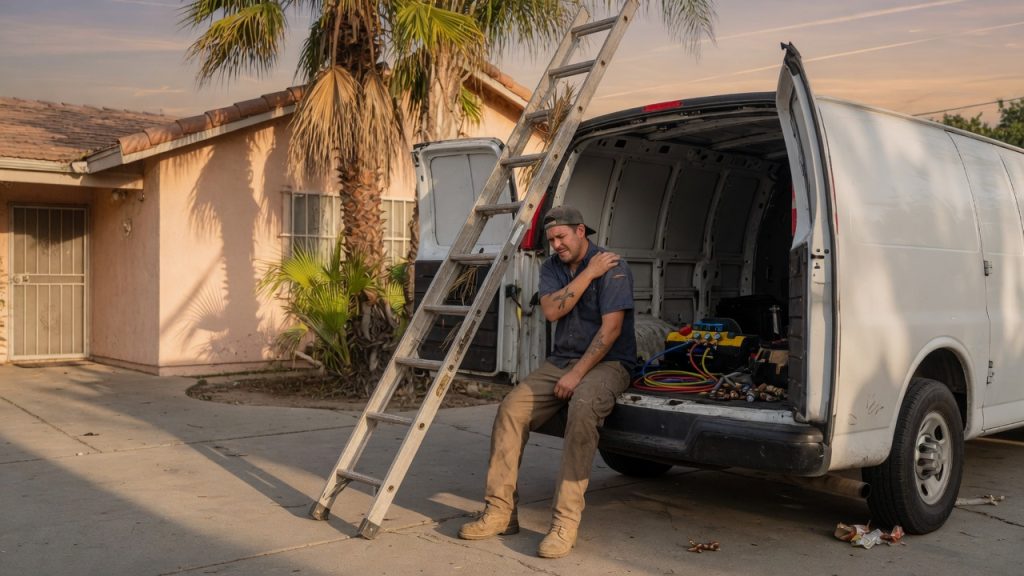
Yes. If you got hurt doing HVAC work in California, you can usually receive workers’ compensation. That includes medical care and a portion of your lost wages, even if the fall, the lift, or the shock was an accident. Installers, service techs, and helpers are covered when they are employees. You do not have to prove the company was careless. You do have to report the injury, get medical care, and file the claim on time. A 1099, a piece-rate install, or the fact that you were on a roof instead of in a shop does not automatically end the claim.
Attics in Orange County are not a personality test. A shoulder that gives out bringing a condenser up a ladder can still be a work injury.
Laguna Law Firm has spent more than 20 years helping injured workers across California. For a straight answer, call (949) 930-1386 or visit lagunalawfirm.com. The consultation is free.
The short version of how this works
California’s workers’ compensation system is no-fault. The insurance company is supposed to pay for a work injury without a courtroom fight over who set the ladder. In exchange, you generally cannot sue the HVAC company for pain and suffering the way you might after a car crash.
You can be hurt in one moment. A ladder kicks out. A unit shifts. A shock off a disconnect. You can also be hurt slowly. Backs, knees, and shoulders wear out from attics, roofs, and the same compressors, year after year. California treats that cumulative trauma as a work injury too.
Coverage generally starts day one for employees. It does not matter if you are a helper, on call, or new to the van.
Who is actually covered?
Service techs and install crews. If the company dispatches the call, owns the van, and tells you which system is next, you look like an employee. A W-2 makes it simple. The claim can still exist when pay is a day rate plus a commission on the install.
Helpers and apprentices. You do not need your own contractor license to be covered. The person on the low end of the duct, or the person in the attic handing tools down, is still working.
1099 techs. California generally requires a C-20 warm-air heating, ventilating, and air-conditioning contractor license when the work is $1,000 or more in labor and materials, or when the job needs a permit. Assembly Bill 2622 raised that small-job line from $500 to $1,000 on January 1, 2025. Labor Code section 2750.5 can treat a person who performs work requiring a contractor’s license, without holding that license, as an employee of the hirer. It is a presumption with edges. Bring who set the hours, who supplied the refrigerant and the van, and whether you could turn the job down. Our misclassification article is the longer version.
Two companies on one job. A general contractor, an HVAC sub, and a crane or roofing crew can mean more than one employer and more than one insurance policy. Write down every truck on the street.
Undocumented workers. California workers’ compensation does not require U.S. citizenship. If you were working and you got hurt, you can still have a claim.
What kinds of HVAC injuries actually qualify?
Almost any injury that arises out of the job and happens in the course of the job.
- Falls from ladders, roofs, and attic hatches
- Back and shoulder injuries from condensers, air handlers, and duct
- Knee injuries from crawling units and roof pitches
- Electrical shock and burns
- Heat illness in attics and on roofs
- Cuts from sheet metal
- Refrigerant exposure and breathing problems, when the medicine supports it
- Vehicle crashes between service calls
Heat on a roof or in an attic is still a workers’ compensation injury. You do not need an OSHA citation first. The longer note is in our heat-illness article. If the fall is from a roof, the medical story overlaps with other height work, but the employer and the wage math are the HVAC job. Our roofing accidents guide is useful on falls. This page stays with heating and air conditioning work.
If a lead told you to finish the change-out after you reported pain, write down the date, the name, and what they said.
The HVAC wrinkle: attics, ladders, and “finish the install”
Height is not a defense. Getting hurt because the unit is on the roof does not mean you assumed the risk in some way that cancels workers’ compensation. You do not have to prove the ladder was illegal. You do have to say where you were and what you were carrying.
The customer’s house is the workplace. A rotten roof deck, a homeowner’s dog, or a deck the general contractor left open can be part of your claim against your employer. It can also be a separate civil case against someone who is not your employer: the homeowner in the right facts, another contractor, or the maker of a failed ladder or unit. Those cases have different deadlines and can include pain and suffering. Do not sign a form on the tailgate that gives the second claim away.
On-call and commission pay belong in the wage rate. Temporary disability is generally two-thirds of average weekly earnings, inside state minimums and maximums. A carrier that uses only your hourly draw and ignores install commission will underpay you. Bring dispatch records, commission sheets, and the weeks that were busy, not only the week you got hurt.
Van time between calls is often covered. The drive from home to the first job is a more careful question under the going-and-coming rule. Driving from a no-cool call in one city to a change-out in the next, in the company van, is usually the job. Write down both addresses.
What workers’ compensation actually pays
Medical treatment. Doctor visits, imaging, physical therapy, surgery, prescriptions, and mileage to appointments. Authorized care for the work injury should not come out of your pocket.
Temporary disability (TD). If you cannot work, or you can only work reduced hours, you may get wage replacement. For injuries on or after January 1, 2026, the Division of Workers’ Compensation set the minimum weekly temporary total disability rate at $264.61 and the maximum at $1,764.11. The rate follows the date of injury. There is usually a short waiting period, often three days, unless you are hospitalized or off long enough for it to be waived.
Permanent disability (PD). If the injury leaves lasting limits, you may receive a permanent disability award based on a medical rating. HVAC work means ladders, attics, heat, and weight. The rating should match that job, not a restriction that says you can do “light work” with no description of a condenser.
Supplemental Job Displacement Benefit. If you cannot go back to your old job and the employer does not offer qualifying alternative work, you may get a voucher for retraining. In many cases that voucher is up to $6,000.
Death benefits. If a worker dies from a work injury, dependents may have a claim. Falls and electrical injuries are not theoretical in this trade.
Notice what is not on that list: a big pain-and-suffering check from the HVAC company itself. That is the trade-off of the no-fault system.
What to do in the first 48 hours
- Get medical care. ER after a fall, a shock, a blow to the head, or confusion in the heat. Tell them it happened at work.
- Tell the person who runs the board, the same day if you can.
- Text a follow-up: date, body part, and the job address.
- Ask for the DWC-1 claim form. Fill out the employee section. Keep a copy.
- Photograph the ladder or the attic opening only if you can do it safely from the ground or from a stable step. Do not climb back up.
- Write down witnesses. The helper, the homeowner, the other trade on the roof.
- Be careful with a recorded statement. You can be polite and still say you want to talk to a lawyer first.
California Labor Code section 5400 says you should notify your employer within 30 days. Once the DWC-1 is filed, the claims administrator generally has 90 days to accept or deny under Labor Code section 5402. If the claim is denied or the file stalls, the backstop is usually one year to file at the Workers’ Compensation Appeals Board under Labor Code section 5405.
See our top 10 tips for injured workers in California and what to do when a claim is delayed.
How Laguna Law Firm helps injured HVAC techs
We are a California workers’ compensation firm. What that looks like: we sort employee versus 1099, we put commission and on-call pay into the wage rate, we file what still needs filing, and we fight ratings that ignore ladders and attics. We look for a third-party case only when the facts support one.
A California workers’ compensation attorney is typically paid on a contingency fee set by the Workers’ Compensation Appeals Board. You do not write a big retainer check to get started. If there is no recovery, the attorney fee generally is not owed. We will explain the fee in plain English on the first call.
Call (949) 930-1386. Or go to lagunalawfirm.com and send a note. Bring the dispatch texts.
Frequently asked questions
I am a helper and I do not have a license. Am I covered?
If you were an employee, yes. The license question matters more when someone calls you a contractor and you were doing work that needed a C-20.
I fell off the customer’s roof. Is that the homeowner’s case instead?
It can be both. Your employer’s workers’ compensation claim is the first track. A homeowner, another contractor, or a defective ladder can be a second track. Do not pick one and ignore the other.
The company says roof work is “at your own risk.”
A sentence in a group text does not cancel the Labor Code. Report the injury.
Install season pays more than winter. Which weeks count?
Average earnings are supposed to reflect what you actually made, not the slowest month on the calendar. Bring the commission sheets from the period before the injury.
Can I pick my own doctor?
It depends on the Medical Provider Network and where you are in the claim. Ask before you sign what the service manager hands you.
Bottom line
An HVAC technician hurt on the job in California can receive workers’ compensation. The setting can be an attic, a roof, or the company van between calls. The pay can include commission the stub barely shows. The claim can still be real.
The hard part is the 1099 label, the ladder story, and a rating that pretends you do not carry equipment. That is the part we handle.
Laguna Law Firm
Phone: (949) 930-1386
Web: lagunalawfirm.com
Free case review. You talk, we listen, then we tell you what we think. No pressure routine, no mystery bill.