
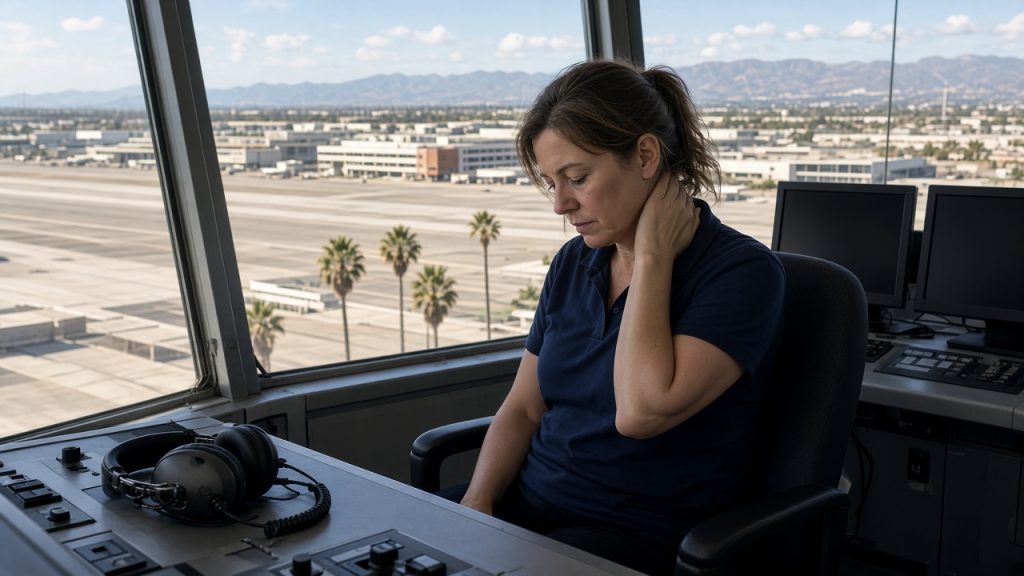
Yes, if you were hurt controlling traffic, you have a claim to look at. The system depends on who employs you. If the Federal Aviation Administration pays you, the claim is federal. It runs under the Federal Employees’ Compensation Act, through the Office of Workers’ Compensation Programs in the Department of Labor. It is not a California DWC-1, and it does not go to the Workers’ Compensation Appeals Board. If a private company employs you at a contract tower, you can usually receive California workers’ compensation when you are that company’s employee.
People finish the push because the next arrival is already on the frequency. Then the neck does not come back at the end of the shift. A fall on the tower stairs, or a neck and shoulder that gave out after years of the same position, can still be a work injury.
Laguna Law Firm has spent more than 20 years helping injured workers across California. For a straight answer about which system you are in, call (949) 930-1386 or visit lagunalawfirm.com. The consultation is free.
The short version of how this works
An FAA employee does not file the California claim form. Controllers, supervisors, and other FAA employees on the federal payroll use the federal forms. A traumatic injury, one that happens in a work shift from a specific event, starts on Form CA-1. A condition that builds over time starts on Form CA-2. The agency is supposed to send the form on. Keep a copy. The Department of Labor’s program is where that file is decided.
You generally cannot sue the FAA for pain and suffering for the work injury. That is the trade-off of the federal act. A different person can still be a civil case. The driver who hits you in the parking lot, if that drive was not your commute and the facts support it, is not your employer. Most of a controller’s injury is the work at the scope, and that work claim is the federal one when the FAA pays you.
A contract tower is a different employer. The FAA Contract Tower Program uses private companies to staff towers. Those controllers are employees of the company, not of the FAA, even though the certification and the phraseology are the FAA’s. If that company sets your schedule and signs the paycheck, you look like that company’s employee, and the claim can be a California workers’ compensation claim when the tower is in California. Write down the name on the paycheck before you pick a form.
Who is actually covered?
FAA employees. If the FAA assigns the facility and pays you, you are in the federal system. Towers, TRACONs, and en route centers are all workplaces. A developmental controller is still an FAA employee. The sentence “you are not certified yet” does not close the federal claim.
Contract-tower controllers. Contract towers are staffed by private companies under the FAA’s program. Companies that have held that work include Serco, Midwest Air Traffic Control Service, and Robinson Aviation (RVA). A later contract can put a different name on the stub. Bring the current name. The California claim uses the DWC-1, not Form CA-1. Our misclassification article is the longer version only if the company calls an employee a contractor. The usual contract-tower controller is a W-2 employee of the company.
Do not guess the airport. Some busy facilities are FAA. Many smaller towers are contract towers. The paycheck decides it. We will not treat a facility as one or the other from the city name alone.
Active-duty military controllers. That is a military line. It is not a California DWC-1, and it is not the civilian Form CA-1. Bring the orders.
Two careers in one month. Some people leave the FAA and take a contract-tower job, or the other way around. Those can be two employers and two systems. Write down both, and which one you were working for on the day you got hurt.
What kinds of controller injuries actually qualify?
For an FAA employee, the federal act covers an injury in the performance of duty. In a facility, that means:
- Falls on tower stairs, in the cab, or in the TRACON
- Neck, shoulder, and back injuries from headsets, consoles, and years of the same position
- A specific event on position, including an injury in one shift
- A condition that built over time from the work of separating traffic
Tell the doctor it happened at work, and say whether it was one event or years of the position. Use the form that matches the facts. A fall on the stairs is a traumatic-injury pattern. A neck that wore out over years at the scope is the occupational-disease pattern. Do not let a supervisor pick the quieter form to shrink the claim.
The regular work of the position can be a factor in a federal claim. A dispute about staffing, discipline, or a bid is a different question. Those administrative fights are often outside the federal act even when they feel like the job. Write down what actually happened. Do not file a stress claim that is only a fight about a schedule, and do not drop a claim that is about the work on position.
For a contract-tower employee, the same kinds of injuries can be California workers’ compensation injuries. The test is the state test: arising out of and in the course of the job. The form is the DWC-1. The employer is the company.
The drive from your house to the facility in your own car is usually a commute, in both systems. Write down where you were. Our going-and-coming article explains the California version of that line. A federal claim uses the federal performance-of-duty test.
The facility wrinkle: continuation of pay is not the California rate
Continuation of pay is not California temporary disability. For a traumatic injury, continuation of pay can continue an FAA employee’s regular pay for up to 45 calendar days. You generally have to file Form CA-1 within 30 days of the injury. Occupational-disease claims on Form CA-2 do not get continuation of pay. This is the general federal rule. It is not the three-day rule that applies to Postal Service employees. Do not use a postal article to time an FAA claim.
Missing the 30 days can cost the continuation of pay and still leave the claim alive. An original claim for compensation generally has to be filed within three years under 5 U.S.C. section 8122. The time can be met if your supervisor had actual knowledge of the injury within 30 days, or if written notice was given within 30 days. For a condition that shows up later, the three years often run from the date you were aware, or should have been aware, of the connection between the disability and the work. File anyway. The early form is what protects continuation of pay.
After continuation of pay, wage-loss compensation is partial. If the federal office accepts the claim and you are still off work, compensation for total disability is generally two-thirds of pay, or three-fourths if you have an eligible dependent. That is not the California temporary disability schedule. The 2026 California rates do not set an FAA claim.
A lasting impairment is a schedule award, not a California permanent disability rating. The federal system uses its own rating. Do not expect the state rating chart to decide the number.
Your health insurance is not a substitute. You should not have to run a work injury through a personal plan because the facility does not want a form. You should not have to burn sick leave for the whole absence if continuation of pay or compensation applies.
What a contract-tower employee gets instead
If the paycheck is from a private company, stop and use the California system. That claim uses the DWC-1, not Form CA-1. Working in a tower the FAA regulates does not make you a federal employee. California Labor Code section 5400 says you should notify that employer within 30 days. Once the DWC-1 is filed, the claims administrator generally has 90 days to accept or deny under Labor Code section 5402. The backstop is usually one year to start a case at the Workers’ Compensation Appeals Board under Labor Code section 5405. Cumulative trauma often runs from the date you first had disability and knew, or should have known, the work was causing it, under Labor Code section 5412.
For a California injury on or after January 1, 2026, the Division of Workers’ Compensation set the minimum weekly temporary total disability rate at $264.61 and the maximum at $1,764.11. Those numbers follow the date of injury. They do not apply to an FAA claim. Many California claims also face a time cap, often 104 weeks within a five-year window, with exceptions for some severe injuries. A contract-tower employee who cannot return to the old job may qualify for a Supplemental Job Displacement Benefit voucher, in many cases up to $6,000.
For the California punch list, see our top 10 tips for injured workers in California. If that employer or its insurer is sitting on the file, read what to do when a claim is delayed. If shifts disappear after you report the injury, look at Labor Code 132a retaliation protections. Those state protections are for the California job. An FAA employee has federal rules instead, and we will not pretend they are the same statute.
What to do in the first 48 hours
- Get medical care. ER if you fell, you hit your head, or you cannot walk. Urgent care or a real exam if it is not an ambulance. Tell them it happened at work.
- Tell your supervisor the same day if you can.
- If the FAA employs you, ask for Form CA-1 for a one-event injury or Form CA-2 for a condition that built over time. Fill out the employee section. Keep a copy. File the CA-1 within 30 days if you want to protect continuation of pay.
- If a private company employs you, ask that company for the DWC-1. Keep a copy.
- Write down the facility, the position, and the name on the paycheck.
- Photograph the stairs or the scene if it is safe. Do not leave a position uncovered to take the picture.
- Be careful with recorded statements to an insurance adjuster. You can be polite and still say you want to talk to a lawyer first.
How Laguna Law Firm helps injured controllers
We are a California workers’ compensation firm. The first thing we do on a facility injury is sort the employer. If the FAA pays you, we will tell you that the claim is federal, that the form is a CA-1 or a CA-2, and that the California DWC-1 is the wrong piece of paper. If a contract-tower company pays you, we handle the California claim: the wage rate, the filing, and the treatment delays.
A fee on a federal compensation claim has to be approved under the federal rules. It is not the fee schedule of the California Workers’ Compensation Appeals Board. On a California workers’ compensation claim, the fee is typically a contingency fee set by the Appeals Board. You do not write a big retainer check to get started on that state claim. If there is no recovery, that state fee generally is not owed. We will tell you which file you have, and we will explain the fee in plain English, before anyone treats an FAA injury like an ordinary state claim.
Call (949) 930-1386. Or go to lagunalawfirm.com and send a note. Virtual consults are available. Bring the pay stub so we can see the employer.
Frequently asked questions
I work a tower, a TRACON, or a center for the FAA. Which form?
If the FAA employs you, use Form CA-1 for one event and Form CA-2 for a condition that built over time. The California DWC-1 is the wrong form.
I work a contract tower.
That can be a California workers’ compensation claim against the company that pays you. Bring the stub. Do not file an FAA form unless the FAA is the employer.
The neck wore out over years on position. Which form is that?
That pattern is usually Form CA-2 when the FAA is the employer. Continuation of pay is for traumatic injuries on Form CA-1. Say how the neck actually started.
Will the California 2026 disability rates apply to me?
They apply to a California workers’ compensation claim for an injury on or after January 1, 2026. They do not set the benefit on an FAA claim.
Is the postal three-day rule my rule?
No. That rule is for Postal Service employees. An FAA traumatic injury looks to continuation of pay, up to 45 calendar days, when the CA-1 is filed in time.
The supervisor told me to use sick leave and skip the form.
Write down the name and the date. Ask for the form anyway. Sick leave is not a substitute for the claim.
Bottom line
A controller hurt on the job has a claim. If the FAA pays you, file it on the federal form, and protect the 30-day continuation-of-pay window when the injury was one event. If a contract-tower company pays you, the California claim is the right file. The facility type does not decide it. The paycheck does.
The hard part is filing in the wrong system, burning sick leave in place of the right benefit, and using a postal rule or a California rate on an FAA claim. That is the part to sort first.
Laguna Law Firm
Phone: (949) 930-1386
Web: lagunalawfirm.com
Free case review. You talk, we listen, then we tell you what we think. No pressure routine, no mystery bill.