
Yes. If you got hurt doing airline work and California is the right system, you can usually receive workers’ compensation when you are an employee. That includes medical care and a portion of your lost wages. You do not have to prove the airline or the contractor was careless. You do have to report the injury, get medical care, and file the claim on time.
The name on the tail is often the wrong name. A mainline brand, a regional carrier, and a ramp contractor can be three different employers. The paycheck is the starting point. Where you were hired, where you are based, and where you got hurt decide whether the file is a California DWC-1 or another state’s claim.
We already published a general look at airline injuries and the usual claim steps: workers’ compensation for airline industry employees. This article is the question that overview leaves open. Whose name is on the stub, and which state covers a crew injury away from California.
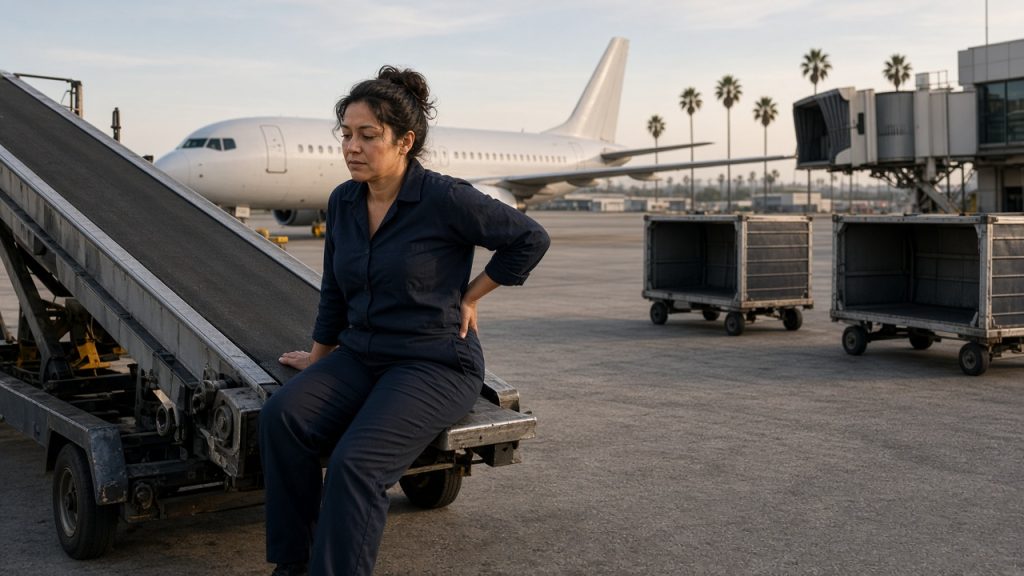
People finish the turn because the next flight is already at the gate. Then the back does not come back at the end of the shift. A fall on the belt loader, or a shoulder that gave out after years of the same bins, can still be a work injury.
Laguna Law Firm has spent more than 20 years helping injured workers across California. For a straight answer about which employer and which state you are in, call (949) 930-1386 or visit lagunalawfirm.com. The consultation is free.
The short version of how this works
When California is the right system, workers’ compensation is no-fault. The insurance company is supposed to pay for a work injury without a fight over who left the bag in the aisle. In exchange, you generally cannot sue your own employer for pain and suffering.
You can be hurt in one moment. A fall from a belt loader. A galley cart in turbulence. A tug that stops short. You can also be hurt slowly. Years of bins, carts, and lavatory lifts can wear out a back, a shoulder, or a knee. California treats both as work injuries when the job caused them. The slower ones are called cumulative trauma.
The form follows the employer. If a private airline or a private contractor pays you, and California law applies, the form is the DWC-1. If the Transportation Security Administration pays you, the claim is federal. Airport firefighters and air traffic controllers are different employers, and they are different articles.
The 2026 California temporary disability rates apply only to a California claim. They do not set the check if another state’s program is the exclusive remedy against the employer.
Who is actually covered?
Mainline airline employees. If the airline assigns the base, builds the pairing, and signs the paycheck, you are that airline’s employee. Pilots, flight attendants, ramp agents, and maintenance employees on that payroll can all be covered. A probationary period, a reserve line, or the sentence “you are still in training” does not close the claim.
Regional carriers. A lot of flying is done by a regional airline in another carrier’s colors. Passengers see one brand. The stub shows a different company. File against the company that pays you. Write down both names. The paint belongs in the story. The stub is the employer until the facts show that someone else also employed you.
Below-wing contractors. Catering, cabin cleaning, wheelchairs, fueling, and ramp work are often a vendor’s employees, even when the vest or the truck sits next to a famous airline. If that vendor sets the shift and signs the paycheck, you look like that vendor’s employee. We will not guess the vendor from the airport. Bring the stub. If the vendor calls an employee an independent contractor, our misclassification article is the longer version. Most people on an airline or vendor schedule are employees.
Maintenance on someone else’s certificate. A mechanic paid by the airline is the airline’s employee. A mechanic paid by a repair company is that company’s employee, even when the airplane wears another name. Write down who assigned the task and who paid the week you got hurt.
People hired outside California who are only here for a turn. That pattern can fall under a real exemption. It is covered below. Do not assume a California airport on the pairing makes every injury a California claim. Do not assume an out-of-state hire erases a California base.
Undocumented workers. California workers’ compensation does not require U.S. citizenship. If you were working and you got hurt, and California is the right system, you can still have a claim. There is a longer note in our guide for undocumented workers.
Screeners, airport firefighters, and controllers. If the Transportation Security Administration pays you, the claim is federal, under the Federal Employees’ Compensation Act. The form is a CA-1 for one event or a CA-2 for a condition that built over time. It is not a DWC-1, and the California rates in this article do not set it. Airport firefighters have their own presumptions, covered in our 2026 airport-firefighter article. Air traffic controllers are a different employer again. A controller paid by the FAA is federal. A controller paid by a contract-tower company can be a California claim. None of those jobs is decided by the airline’s policy.
A city or airport-authority paycheck. If the public agency signs the stub, the claim is against that agency’s program. It is a different employer from the airline at the gate.
If you are not sure which bucket you fall into, bring the pay stub, the base, and the pairing or the shift sheet.
What kinds of airline injuries actually qualify?
Almost any injury that arises out of the job and happens in the course of the job, when California is the right system. On this work, that means:
- Back, shoulder, and knee injuries from bags, bins, carts, and lavatory lifts
- Falls on a belt loader, a jet bridge, aircraft stairs, or a wet ramp
- Injuries in turbulence, including being thrown into a cart or a bulkhead while you are working
- Being struck by a tug, a belt loader, a catering truck, or a bin
- Burns, chemical exposure, and hearing loss from the ramp
- Injuries while deadheading on a required assignment, or during a mandated layover
- A cumulative trauma claim after years of the same turns
- Heat illness on the ramp
A required deadhead is work. A mandated layover is work. A slip in the crew hotel on that required overnight is a fact pattern to report. A personal detour on that layover is a different fact. The ordinary drive from your house to the base airport, in your own car, is usually a commute. Our going-and-coming article is the longer version. If the injury is a crash in a company van or on a work errand, our work-related car accident article covers that pattern.
A physical injury from an assault is a work injury. Psychiatric claims have extra rules under Labor Code section 3208.3, including a predominant-cause test and, in many cases, a six-month employment rule. A violent act can change those rules. Flight attendants do not receive the firefighter post-traumatic stress presumption. Write down what happened.
A crew member hurt while working a flight files that injury against the employer as workers’ compensation when California is the right system. Treat it as the employer’s claim. A required ride on another carrier, or a jetway, tug, or part that belongs to a different company, can be a separate civil case. That civil case can include harms the workers’ compensation claim leaves out. It does not replace the claim against your employer. Do not give a recorded statement to the other company’s insurer, and do not sign a paper that gives either file away.
The trip wrinkle: the base, the hire, and the other state
Hired here, or regularly working here, and hurt somewhere else. Labor Code section 3600.5(a) says an employee who has been hired or is regularly working in California, and who receives a personal injury by accident arising out of and in the course of employment outside this state, is entitled to compensation according to California law. A California base can matter even when you sleep in another state. The statute does not add a residence test. A crew member who is based in California and flies from that base is in the “regularly working in the state” group for an injury on a trip.
Section 3600.5(a) is written for a personal injury by accident. A back or a shoulder that wore out over years of turns is still a work-injury question. Bring the base and the date you first knew the work was causing it. Use that date for a cumulative trauma claim under Labor Code section 5412.
Residence plus a California contract of hire. Labor Code section 5305 is a second statute, and it uses a different test. The Division of Workers’ Compensation and the Workers’ Compensation Appeals Board have jurisdiction over an injury outside California when the employee is a resident of this state at the time of the injury and the contract of hire was made in this state. That employee, or the employee’s dependents, is entitled to the compensation or death benefits of this division. The statute uses both residence and the place of hire. Where you accepted the job is part of the hire question. A training address in another state is a fact to bring. It does not, by itself, answer the question. How a court applies the residence words on a particular file is a legal question. Bring the facts. Do not treat a blog as the ruling.
Hired outside California, and only temporarily here. Labor Code section 3600.5(b) can exempt that employee and that employer from California’s workers’ compensation law while the employee is temporarily in California doing work for the employer. The employer has to have furnished workers’ compensation coverage under the laws of another state so that the coverage includes the work in California. Two more conditions have to be true. The other state has to recognize California’s extraterritorial provisions. Employers and employees who are covered in California have to be likewise exempted from that other state’s law. When those conditions are met, the other state’s benefits and remedies are the exclusive remedy against the employer for an injury received while working for that employer in this state.
A crew member whose base, hire, and regular work are somewhere else, and who is on the ground in California for a turn, is the pattern that exemption is written for. It still requires the insurance and the reciprocity. An injury inside a California airport does not always stay in California. A letter that says “you are covered in another state” does not always meet the test.
A certificate is evidence. It is one piece of the file. Labor Code section 3600.5(f) says a certificate from the other state’s board, certifying that the employer is insured there and has provided extraterritorial coverage for employees working in California, is prima facie evidence that the employer carries that insurance. Prima facie means it counts as evidence. The rest of subdivision (b) still has to be looked at.
The athlete rules in the same section stay with athletes. Subdivisions (c), (d), and (e) of section 3600.5 are about professional athletes in baseball, basketball, football, ice hockey, and soccer. The duty-day percentages in those subdivisions are part of that athlete test. Airline crews do not use them. Do not let a carrier apply a ballplayer percentage to a pairing.
Money already paid in another state can change the math. If another state opened a file, keep every letter and every payment record. Those payments can affect a California claim. Opening the other file does not, by itself, decide whether California also applies. Bring both.
Your health insurance is not a substitute. You should not have to run a work injury through a personal plan because the base does not want a claim. You should not have to burn sick leave in place of temporary disability if California benefits apply.
What California workers’ compensation actually pays
These are the benefits when the claim is a California workers’ compensation claim. Skip this list if the section 3600.5(b) exemption makes another state’s program the exclusive remedy against the employer, and skip it for a federal TSA claim.
Medical treatment. Doctor visits, imaging, physical therapy, surgery, prescriptions, and mileage to appointments. Authorized care for the work injury should not come out of your pocket.
Temporary disability (TD). If you cannot work, or you can only work reduced hours, you may get wage replacement. In California that is generally two-thirds of your average weekly earnings, subject to state minimums and maximums. For injuries on or after January 1, 2026, the Division of Workers’ Compensation set the minimum weekly temporary total disability rate at $264.61 and the maximum at $1,764.11. The rate follows the date of injury. Reserve days, premiums, and real extra hours belong in the wage math when they were real earnings. There is usually a short waiting period, often three days, unless you are hospitalized or off long enough for it to be waived. Many claims also face a time cap, often 104 weeks within a five-year window, with exceptions for some severe injuries.
Permanent disability (PD). If the injury leaves lasting limits, you may receive a permanent disability award based on a medical rating. A ramp, a galley, and a cockpit are not desk jobs. The rating should reflect the actual work.
Supplemental Job Displacement Benefit. If you cannot go back to your old job and the employer does not offer qualifying alternative work, you may get a voucher for retraining. In many cases that voucher is up to $6,000. Bring any return-to-work offer in writing before you turn it down.
Death benefits. If a worker dies from a work injury, dependents may have a claim.
Notice what is not on that list: a pain-and-suffering check from your own employer. That is the trade-off of the no-fault system. A different company’s jetway, tug, or part is a different question.
What to do in the first 48 hours
- Get medical care. ER if you fell, you hit your head, you were in a vehicle strike, or you cannot walk. Urgent care or a real exam if it is not an ambulance. Tell them it happened at work, and name the city.
- Tell your supervisor the same day if you can. If you are on a layover, tell the person the airline or the contractor told you to call.
- Follow up in writing. Text or email with the date, the body part, the city, and the flight or the shift.
- If a private airline or a private contractor pays you, ask that employer for the DWC-1 claim form. Fill out the employee section. Keep a copy. If someone says another state is the only file, write down who said it, and still ask for the form.
- If TSA pays you, ask for Form CA-1 for one event or Form CA-2 for a condition that built over time. Keep a copy.
- Save the stub, the base, and the pairing or the shift sheet. Write down where you accepted the job.
- Photograph the scene if it is safe and you are clear of moving aircraft and vehicles. Do not walk onto a live ramp for the picture.
- Be careful with recorded statements to an insurance adjuster, including another company’s insurer. You can be polite and still say you want to talk to a lawyer first.
California Labor Code section 5400 says you should notify your employer within 30 days. That notice rule is for a California claim. Verbal notice can count. Written notice is what you can prove. If you already blew past 30 days, report it now anyway, in writing.
Once the DWC-1 is filed, the claims administrator generally has 90 days to accept or deny under Labor Code section 5402. If they do not deny in time, the injury can be presumed compensable. While they investigate, they are supposed to authorize medical treatment up to a statutory cap.
If the carrier says no, or the file stalls, the backstop is usually one year to start a case at the Workers’ Compensation Appeals Board under Labor Code section 5405. Cumulative trauma claims often run from the date you first had disability and knew, or should have known, the work was causing it. That rule is Labor Code section 5412. A civil case against another company has its own, often shorter, deadline. Do not wait on that one.
For a longer punch list, see our top 10 tips for injured workers in California. If the employer or the insurer is sitting on the file, read what to do when a claim is delayed. If trips or shifts disappear after you report the injury, look at Labor Code 132a retaliation protections. Those state protections are for the California job.
How Laguna Law Firm helps injured airline workers
We are a California workers’ compensation firm. The first thing we do on an airline injury is sort the paycheck and the state. If a private airline or a ground contractor pays you, and California law applies, we handle that claim: the wage rate, the filing, and the treatment delays. If TSA pays you, we will tell you the claim is federal and the DWC-1 is the wrong piece of paper. If another state’s exemption might apply, we read section 3600.5(b) against the stub, the base, and the policy letter before anyone picks a form from the paint on the tail.
What that looks like on a California file: we review what you told the supervisor, we sort the regional carrier from the brand on the airplane, we build the wage rate from the earnings they left out, we file what still needs filing, and we fight treatment delays and stingy ratings. We look for a case against a different company only when the facts support one.
A California workers’ compensation attorney is typically paid on a contingency fee set by the Workers’ Compensation Appeals Board. You do not write a big retainer check to get started on that state claim. If there is no recovery, the attorney fee generally is not owed. We will explain the fee in plain English on the first call, and we will tell you if the file is not a California claim.
Call (949) 930-1386. Or go to lagunalawfirm.com and send a note. Virtual consults are available. Bring the pay stub and the pairing.
Frequently asked questions
The tail says one airline. My stub says a regional carrier.
File against the company that pays you. Write down both names. The paint is part of the story. The stub is the employer until the facts show that someone else also employed you.
I work the ramp for a contractor.
If that contractor sets your shift and signs the paycheck, you look like that contractor’s employee. Catering, cabin cleaning, wheelchairs, fueling, and ramp work are the same question. Bring the stub. The airport name does not identify the vendor.
I got hurt on a layover outside California.
If you were hired in California or you regularly work from a California base, Labor Code section 3600.5(a) can make that injury a California claim when it happened in the course of the job. Write down the city, the pairing, and the base. A required layover is work. A personal detour is a different fact.
I got hurt in California, and I was hired in another state.
Labor Code section 3600.5(b) can make the other state’s benefits the exclusive remedy against the employer when you were hired outside California, you were only temporarily here, the other state’s coverage includes the California work, and the two states recognize each other’s extraterritorial rules. A certificate under section 3600.5(f) is evidence that the insurance exists. The rest of the test still matters. The athlete percentages in that statute do not apply to airline crews.
I live in California, I accepted the job here, and the injury was on a trip.
Labor Code section 5305 applies when you were a California resident at the time of the injury and the contract of hire was made in this state. The statute uses both. Section 3600.5(a) is the separate test for an employee who was hired here or is regularly working here.
Turbulence threw me into a cart while I was working.
Against the airline that employs you, that is a workers’ compensation injury when California is the right system. If another company owned the jetway, the tug, or the part that hurt you, that company can be a separate civil case. Talk to a lawyer before you sign either file away.
Will the 2026 disability rates apply to me?
They apply to a California workers’ compensation claim for an injury on or after January 1, 2026. The minimum weekly temporary total disability rate is $264.61 and the maximum is $1,764.11. They do not set the benefit when another state’s program is the exclusive remedy, and they do not set a federal TSA claim.
The pain showed up after years of turns, not one fall.
That can be cumulative trauma. Report it. For a California claim, Labor Code section 5412 looks to the date you first had disability and knew, or should have known, the work was causing it.
Bottom line
An airline worker hurt on the job can have a real claim. The paycheck decides the employer: the mainline airline, the regional carrier, or the contractor on the ramp. California law can cover an employee who was hired here or regularly works here, even when the injury happens on a trip. An injury inside California can belong to another state when the Labor Code section 3600.5(b) conditions are actually met. The brand on the tail does not decide it.
The hard part is filing against the paint instead of the stub, using an athlete rule on a crew claim, and treating a required layover as a day off or a commute as a trip. That is the part to sort first.
Laguna Law Firm
Phone: (949) 930-1386
Web: lagunalawfirm.com
Free case review. You talk, we listen, then we tell you what we think. No pressure routine, no mystery bill.