
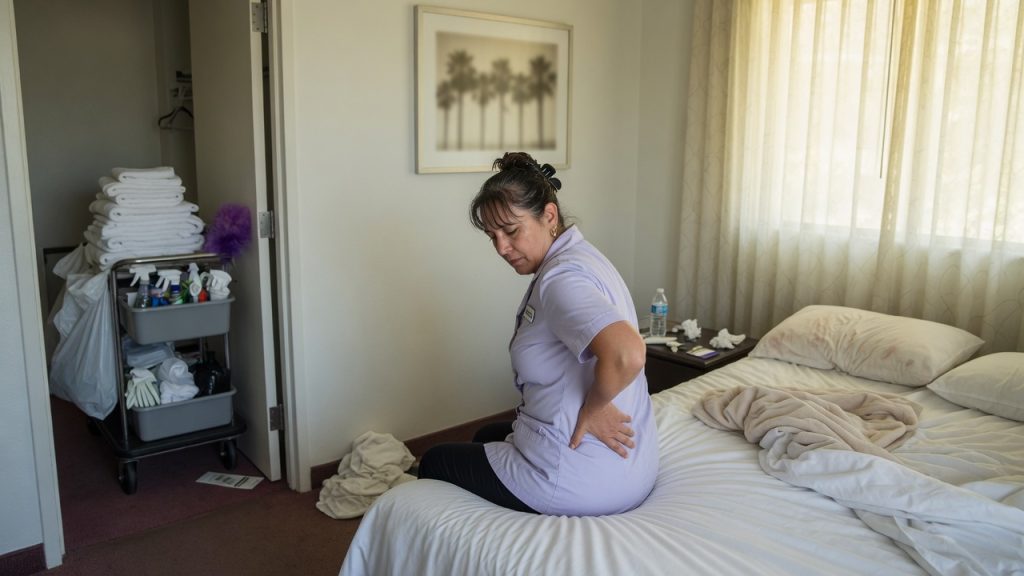
Yes. If you got hurt doing hotel housekeeping in California, you can usually receive workers’ compensation. That includes medical care and a portion of your lost wages, even if the lift, the slip, or the bad step was an accident and nobody did anything “wrong.” Room attendants, housemen, laundry workers, and public-area cleaners are covered when they are employees. You do not have to prove the hotel was careless. You do have to report the injury, get medical care, and file the claim on time. A staffing-agency paycheck does not erase the claim. A room quota does not either.
People finish the floor because the board is still full. Then the back does not loosen up on the drive home. A strain that started on the third checkout can still be a work injury.
Laguna Law Firm has spent more than 20 years helping injured workers across California. For a straight answer, call (949) 930-1386 or visit lagunalawfirm.com. The consultation is free.
The short version of how this works
California’s workers’ compensation system is no-fault. The insurance company is supposed to pay for a work injury without a courtroom fight over who left the bath mat folded wrong. In exchange, you generally cannot sue the hotel for pain and suffering the way you might after a car crash.
You can be hurt in one moment. A wet bathroom. A cart that tips. A linen bag that is heavier than it looks. You can also be hurt slowly. California treats both as work injuries. A shoulder worn out by years of beds and carts is still a work injury. Those slower injuries are called cumulative trauma, and they are common on housekeeping floors.
Coverage generally starts day one for employees. It does not matter if you are part-time, on call, or “just helping through the weekend rush.”
Who is actually covered?
Hotel employees. If the hotel pays you on a paycheck, you are in the workers’ compensation world. A big brand, a franchise, and a small inn follow the same Labor Code if you are an employee. The name on the key card does not change that.
Room attendants and housemen. Making beds, scrubbing baths, moving furniture, and running trash are the job. An injury during any of that is a work injury.
Laundry and public space. The people in the basement laundry and the people on lobby tile get hurt too. Heat, chemicals, and wet floors count.
Staffing agencies. A lot of floors are filled by a temp company. In California that can create dual employment. Do not assume you have no claim because the stub has a different name than the sign out front. Bring both names.
1099 “contractors.” Some properties hand housekeepers a 1099, assign the rooms, and set the start time. A tax form is not the whole test. California looks at control, whether the work is the hotel’s regular business, and whether you actually run your own operation. If the hotel set the rooms, the uniform, and the clock-out, you may be an employee for workers’ compensation even if someone said otherwise.
Undocumented workers. California workers’ compensation does not require U.S. citizenship. If you were working and you got hurt, you can still have a claim. There is a longer note in our guide for undocumented workers.
If you are not sure which bucket you fall into, bring the schedule and a pay record.
What kinds of housekeeping injuries actually qualify?
Almost any injury that arises out of the job and happens in the course of the job. On a hotel floor, that means:
- Back, shoulder, and neck injuries from beds, mattresses, and linen bags
- Wrist and elbow problems from scrubbing and repetitive work
- Knee injuries from bathrooms and long days on hard floors
- Slips and falls on wet tile, tubs, and lobby stone
- Cuts and chemical burns from cleaners
- Breathing problems from sprays and poor ventilation, when the medicine supports it
- Being struck by a cart, a door, or luggage
- A guest assault that causes a physical injury
Psychiatric claims have extra rules. A bruise from a guest does not. Write down the room number, the time, and who you told.
A lot of people wait because the first rooms were “just sore.” Then the limp shows up on the stairs. If a supervisor told you to finish the section after you reported pain, write down the date, the name, and what they said.
If the injury is mainly a fall, our slip-and-fall article goes further on that pattern. This page is about the hotel job.
The hotel wrinkle: quotas, chemicals, and guests
The board is not a legal defense. Getting hurt because checkout was heavy does not kill the claim. You do not have to prove the quota was illegal. If a manager later says you were rushing or skipping steps, write down how many rooms were on the sheet and what time you were told to be done.
Housekeeping chemicals are part of the job. Gloves in a cart do not mean a rash, a burn, or a breathing problem is your private medical issue. Tell the doctor the product name if you know it. A photo of the bottle is useful. Do not keep using the spray “to see if it calms down” after you have already reported a reaction.
A hotel clinic or a manager with a first-aid kit is not the claim. Ice and a bandage can be fine for a small cut. They are not a diagnosis, and they are not a DWC-1. You can still see a doctor who will look at the disc, the rotator cuff, or the knee.
Guests and other companies can be a second case. Workers’ compensation is the claim against the hotel’s policy. A guest who injures you, a defective cart made by another company, or a property owner who is not your employer can create a civil case on top of that. Those cases have different deadlines and can include pain and suffering. You can have both. Do not sign a statement in the office that gives the second claim away because you want to keep the floor.
Your health insurance is not a substitute. You should not have to run a work injury through a personal plan because the hotel does not want a claim. You should not have to burn PTO in place of temporary disability if you qualify for TD.
What workers’ compensation actually pays
Medical treatment. Doctor visits, imaging, physical therapy, surgery, prescriptions, and mileage to appointments. Authorized care for the work injury should not come out of your pocket.
Temporary disability (TD). If you cannot work, or you can only work reduced hours, you may get wage replacement. In California that is generally two-thirds of your average weekly earnings, subject to state minimums and maximums. For injuries on or after January 1, 2026, the Division of Workers’ Compensation set the minimum weekly temporary total disability rate at $264.61 and the maximum at $1,764.11. The rate follows the date of injury. Overtime and extra rooms, if they were real earnings, belong in that number. There is usually a short waiting period, often three days, unless you are hospitalized or off long enough for it to be waived. Many claims also face a time cap, often 104 weeks within a five-year window, with exceptions for some severe injuries.
Permanent disability (PD). If the injury leaves lasting limits, you may receive a permanent disability award based on a medical rating. Housekeeping is not a desk job. The rating should reflect beds, carts, tile, and the pace of a real floor.
Supplemental Job Displacement Benefit. If you cannot go back to your old job and the employer does not offer qualifying alternative work, you may get a voucher for retraining. In many cases that voucher is up to $6,000.
Death benefits. If a worker dies from a work injury, dependents may have a claim.
Notice what is not on that list: a big pain-and-suffering check from the hotel itself. That is the trade-off of the no-fault system.
What to do in the first 48 hours
- Get medical care. ER if you cannot walk, you hit your head, or a chemical is in your eye. Urgent care or a real exam if it is not an ambulance. Tell them it happened at work.
- Tell the person who runs the floor, the same day if you can.
- Follow up in writing. Text or email with the date, the body part, and the room or area.
- Ask for the DWC-1 claim form. Fill out the employee section. Keep a copy.
- Write down who saw it and whether you had already complained about the same body part.
- Photograph the spot if it is safe. Do not climb back into a wet tub for a picture.
- Be careful with recorded statements to an insurance adjuster. You can be polite and still say you want to talk to a lawyer first.
California Labor Code section 5400 says you should notify your employer within 30 days. Verbal notice can count. Written notice is what you can prove. If you already blew past 30 days, report it now anyway, in writing.
Once the DWC-1 is filed, the claims administrator generally has 90 days to accept or deny under Labor Code section 5402. If they do not deny in time, the injury can be presumed compensable. While they investigate, they are supposed to authorize medical treatment up to a statutory cap.
If the carrier says no, or the file stalls, the backstop is usually one year to start a case at the Workers’ Compensation Appeals Board under Labor Code section 5405. Cumulative trauma claims often run from the last day the job was still hurting you.
For a longer punch list, see our top 10 tips for injured workers in California. If the hotel or the insurer is sitting on the file, read what to do when a claim is delayed. If hours disappear after you report the injury, look at Labor Code 132a retaliation protections.
How Laguna Law Firm helps injured hotel workers
We are a California workers’ compensation firm. We help people on hotel floors, in kitchens, on crews, and in shops get medical care authorized and benefits paid.
What that looks like: we review what you told the supervisor, we sort the hotel versus the staffing agency, we build the wage rate from the weeks they left out, we file what still needs filing, and we fight treatment delays and stingy ratings. We look for a guest or product case only when the facts support one.
A California workers’ compensation attorney is typically paid on a contingency fee set by the Workers’ Compensation Appeals Board. You do not write a big retainer check to get started. If there is no recovery, the attorney fee generally is not owed. We will explain the fee in plain English on the first call.
Call (949) 930-1386. Or go to lagunalawfirm.com and send a note. Virtual consults are available. Bring what you have.
Frequently asked questions
I only work banquet weekends. Am I covered?
If you are an employee, part-time and on-call work can still count. The benefit math uses your earnings.
The injury showed up after years of rooms, not one accident.
That can be cumulative trauma. Report it, and use the date you first knew the work was causing it. Do not wait for a single “pop” that never comes.
They paid me cash and there is no poster in the locker room.
Uninsured employers are still a problem California has a path for. It is more technical. You still want a lawyer.
Can I pick my own doctor?
It depends on whether there is a valid Medical Provider Network and where you are in the process. Ask before you sign whatever the supervisor hands you.
A guest says I fell because I was careless.
Report the injury anyway. Fault is not the test in a workers’ compensation claim against your employer. Write down what the guest said and who heard it.
The hotel says I am a contractor.
That is a sentence, not a decision. Bring the schedule, the uniform rules, and how you got the rooms.
Bottom line
A hotel housekeeper hurt on the job in California can receive workers’ compensation. The building can be a tower, a motel, or a boutique inn. The injury can be one wet bathroom or a shoulder that gave out after years of beds. The claim can still be real.
The hard part is not the legal theory. The hard part is the staffing-agency paperwork, the quota conversation, and the fear that tomorrow’s board will not have your name on it. That is the part we handle.
Laguna Law Firm
Phone: (949) 930-1386
Web: lagunalawfirm.com