
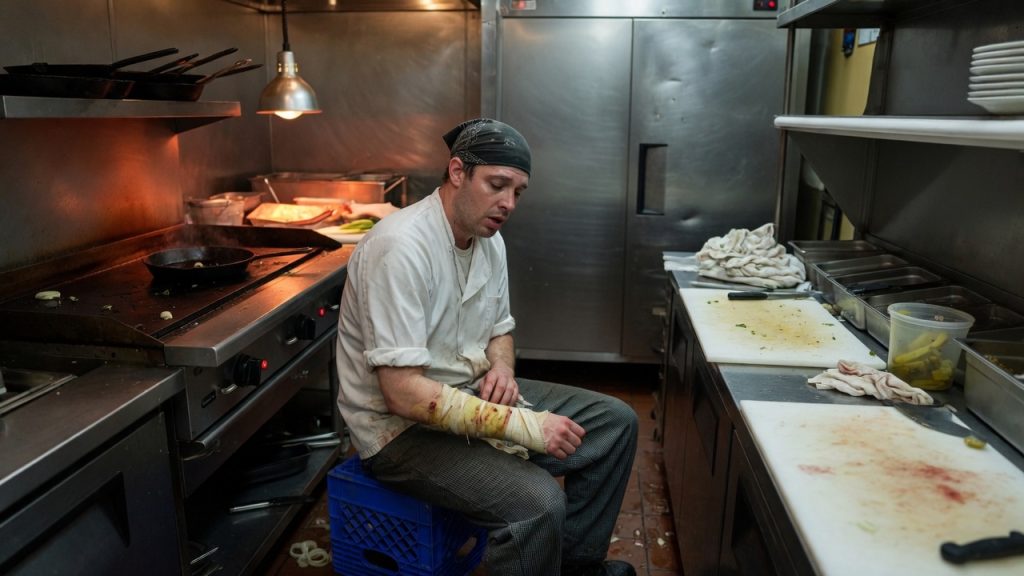
Yes. If you got hurt working in a restaurant or kitchen in California, you can usually receive workers’ compensation. That includes medical care and a portion of your lost wages, even if the burn, the slip, or the bad lift was an accident and nobody did anything “wrong.” Line cooks, prep cooks, dishwashers, servers, bussers, hosts, bartenders, and a lot of fast-food crews are covered. You do not have to prove the owner was careless. You do have to report the injury, get medical care, and file the claim on time. Tips can count toward your wage rate. A 1099 label on a cook who works the owner’s shifts does not automatically kill the claim.
A lot of people wrap a burn in a towel, finish the rush, and decide it will be fine by Monday. Sometimes Monday is a tendon or an infection, and the claim clock has already started without them.
Laguna Law Firm has spent more than 20 years helping injured workers across California. For a straight answer, call (949) 930-1386 or visit lagunalawfirm.com. The consultation is free.
The short version of how this works
California’s workers’ compensation system is no-fault. The insurance company is supposed to pay for a work injury without a courtroom fight over who left the mat curled up. In exchange, you generally cannot sue the restaurant for pain and suffering the way you might after a car crash.
You can be hurt in one ugly moment. Oil jumps. A knife slips. A sheet pan comes out of the oven and the dry towel was not dry. You can also be hurt slowly. California treats both as work injuries. Tendonitis from a year of prep is still a work injury. So is the back that finally goes after a thousand cases of soda. Those slower injuries are called cumulative trauma, and they are common in kitchens.
Coverage generally starts day one for employees. It does not matter if you are part-time, on a trial shift, or “just helping through the weekend.”
Who is actually covered?
W-2 restaurant employees. If the restaurant pays you on a paycheck with taxes taken out, you are in the workers’ compensation world. The name on the awning does not change that. A diner, a hotel banquet kitchen, a steakhouse, and a taco window follow the same Labor Code if you are an employee.
Fast food, dish, and closing crews. Corporate stores and franchise stores both have to cover employees. So do the people who stay after the dining room empties. Wet floors, chemical jugs, and trash runs still count. The letterhead on the claim may be a third-party administrator you have never heard of. That name does not erase the claim.
Servers, bussers, bartenders, and hosts. A fall with a full tray is a work injury. So is a shoulder from carrying plates, and a wrist from a bar station that never slows down. Customer assaults that cause a physical injury can be work injuries too. Psychiatric claims have extra rules. A black eye does not.
Temps and staffing agencies. Banquet houses and some kitchens fill shifts through a temp company. In California that can create dual employment. Do not assume you have no claim because the paycheck has a different company name.
1099 cooks and “contractors.” Some owners hand a cook a 1099, tell them when to show up, tell them the menu, and send them home when it is slow. A tax form is not the whole test. California looks at control, whether the work is the restaurant’s regular business, and whether you actually run your own operation. If the owner set the station, set the hours, and owned the knives, you may be an employee for workers’ compensation even if someone said otherwise. Bring the texts, the schedule, and how you got paid.
Undocumented workers. California workers’ compensation does not require U.S. citizenship. If you were working and you got hurt, you can still have a claim. There is a longer note on that in our guide for undocumented workers.
If you are not sure which bucket you fall into, that is normal. Bring what you have.
What kinds of kitchen injuries actually qualify?
Almost any injury that arises out of the job and happens in the course of the job. In kitchen English, that means:
- Burns from oil, steam, ovens, coffee, and the flat top
- Cuts from knives, slicers, and broken glass
- Slips and falls on water, grease, mats, and the walk-in floor
- Back, shoulder, and knee injuries from lifting cases, pots, and trays
- Wrist, elbow, and hand problems from chopping, plating, and repetitive motion
- Eye injuries from splatter and chemicals
- Breathing problems from cleaners, fryer oil, and poor ventilation, in the right medical facts
- Heat illness on a line that feels like August even in January
- Being hit by a cart, a door, or a delivery in the alley
A lot of people wait because the first night was “just a burn.” Then the burn weeps. Then someone says put aloe on it and work saute. The claim clock does not care that you tried to finish the tickets. If a manager told you to keep working after you reported the injury, write down the date, the name, and what they said.
If the injury is mainly a burn, our workplace burn article goes deeper on treatment. If it is mainly a fall, the slip-and-fall article is the closer read.
The restaurant wrinkle: tips, the rush, and “we handle this in house”
Tips belong in the wage conversation. Temporary disability is generally two-thirds of your average weekly earnings, inside state minimums and maximums. For a lot of servers and bartenders, the hourly line on the stub is the small number. Reported tips, service charges that function as wages, and overtime can be part of earnings. If the carrier builds your rate off $16 an hour and ignores a real tip book, the check will be wrong. Bring point-of-sale tip reports, tip-out records, and tax documents if you have them. Do not let a slow week become the only week they use.
The rush is not a legal defense. Getting hurt because the board was full does not kill the claim. You do not have to prove the restaurant broke a safety rule. If a manager later says you were “unsafe,” write down what the station actually looked like.
First aid in the office is not the claim. A manager with a bandage box is useful for a small cut. It is not a doctor, and it is not a DWC-1. If they rinse a burn and put you back on grill, you can still see a physician who will look at the depth of the burn, the tendon, or the nerve.
Your health insurance is not a substitute. You should not have to run a work injury through a personal plan because the owner does not want a claim on the policy. You should not have to burn a week of PTO in place of temporary disability if you qualify for TD.
Third parties are a separate question. A defective slicer, a fryer made by another company, a delivery driver in the alley, or a landlord who ignored a broken step can create a civil case on top of workers’ compensation. Those cases have different deadlines and can include pain and suffering. You can have both. Do not sign a stack of papers in the office that gives the second claim away because you wanted to get back on the schedule. Call first.
What workers’ compensation actually pays
Medical treatment. Doctor visits, imaging, physical therapy, wound care, surgery, prescriptions, and mileage to appointments. Authorized care for the work injury should not come out of your pocket.
Temporary disability (TD). If you cannot work, or you can only work reduced hours, you may get wage replacement. In California that is generally two-thirds of your average weekly earnings, subject to state minimums and maximums. For injuries on or after January 1, 2026, the Division of Workers’ Compensation set the minimum weekly temporary total disability rate at $264.61 and the maximum at $1,764.11. The rate follows the date of injury, so an older injury uses that year’s cap. There is usually a short waiting period, often three days, unless you are hospitalized or off long enough for it to be waived. TD benefits are generally not taxed the way a paycheck is. Many claims also face a time cap, often 104 weeks within a five-year window, with exceptions for some severe injuries.
Permanent disability (PD). If the injury leaves lasting limits, you may receive a permanent disability award based on a medical rating. This is math, not a vibe. A good lawyer makes sure the rating matches the station you can no longer work.
Supplemental Job Displacement Benefit. If you cannot go back to your old job and the employer does not offer qualifying alternative work, you may get a voucher for retraining. In many cases that voucher is up to $6,000.
Death benefits. If a worker dies from a work injury, dependents may have a claim.
Notice what is not on that list: a big pain-and-suffering check from the restaurant itself. That is the trade-off of the no-fault system.
What to do in the first 48 hours
- Get medical care. ER if the burn is deep, the cut will not stop, or you cannot bear weight. Urgent care or a real exam if it is not an ambulance. Tell them it happened at work.
- Tell the person who actually runs the shift, the same day if you can.
- Follow up in writing. Text or email with the date, the body part, and the station you were on.
- Ask for the DWC-1 claim form. Fill out the employee section. Keep a copy.
- Write down who saw it, what you were cooking or carrying, and whether you had already complained about the same body part.
- Photograph the area if it is safe. Do not reach back over a hot flat top for a picture.
- Be careful with recorded statements to an insurance adjuster. You can be polite and still say you want to talk to a lawyer first.
California Labor Code section 5400 says you should notify your employer within 30 days. Verbal notice can count. Written notice is what you can prove. If you already blew past 30 days, report it now anyway, in writing. Late notice is a problem. Silence is a bigger one.
Once the DWC-1 is filed, the claims administrator generally has 90 days to accept or deny under Labor Code section 5402. If they do not deny in time, the injury can be presumed compensable. While they investigate, they are supposed to authorize medical treatment up to a statutory cap.
If the carrier says no, or the file stalls, the backstop is usually one year to start a case at the Workers’ Compensation Appeals Board under Labor Code section 5405. Cumulative trauma claims often run from the last day the job was still hurting you.
For a longer punch list, see our top 10 tips for injured workers in California. If the restaurant or the insurer is sitting on the file, read what to do when a claim is delayed. If hours get cut after you report the injury, look at Labor Code 132a retaliation protections.
How Laguna Law Firm helps injured restaurant workers
We are a California workers’ compensation firm. That is the work. We help people in kitchens, dining rooms, warehouses, trucks, and jobsites get medical care authorized and benefits paid.
What that looks like in real life: we review what you already told the manager, we build the wage rate with tips and overtime, we sort employee versus 1099, we file what still needs filing, and we fight treatment delays and stingy ratings. We look for a third-party case only when the facts support one.
A California workers’ compensation attorney is typically paid on a contingency fee set by the Workers’ Compensation Appeals Board. You do not write a big retainer check to get started. If there is no recovery, the attorney fee generally is not owed. We will explain the fee in plain English on the first call.
Call (949) 930-1386. Or go to lagunalawfirm.com and send a note. Virtual consults are available. Bring what you have.
Frequently asked questions
The burn happened on a stage shift before I was “officially” hired.
A trial shift where you are doing the restaurant’s work, under their control, can still be employment. Do not assume the missing name tag ends the claim.
They paid me cash and there is no poster in the kitchen.
Uninsured employers are still a problem California has a path for. It is more technical. You still want a lawyer. Do not assume you have nothing.
Will they fire me for filing?
Retaliation for a workers’ compensation claim can be its own problem under Labor Code section 132a. Report the injury anyway. Write down any schedule change that shows up the same week.
The owner says I cannot file because I am 1099.
That is a sentence, not a decision. Bring the facts. We will look at how the line actually ran.
Bottom line
A restaurant or kitchen worker hurt on the job in California can receive workers’ compensation. The room can be a dining room, a dish pit, a banquet kitchen, or a drive-through window. The injury can be a burn, a fall, or a slow grind on the same station. The claim can still be real.
The hard part is not the legal theory. The hard part is the tip math, the 1099 argument, and the feeling that the next schedule will not have your name on it. That is the part we handle.
Laguna Law Firm
Phone: (949) 930-1386
Web: lagunalawfirm.com
Free case review. You talk, we listen, then we tell you what we think. No pressure routine, no mystery bill.