
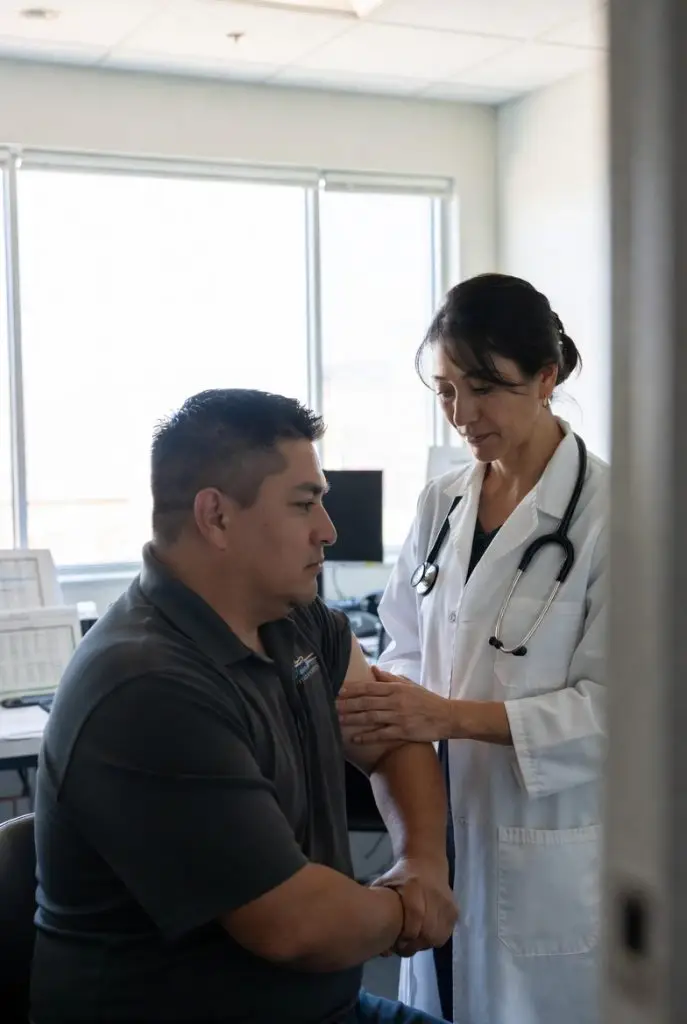
If you’ve been injured on the job in California, you already know the pain, stress, and uncertainty that follow. But what many injured workers don’t realize until it’s too late is that one medical evaluation can make or break their entire workers’ compensation claim. Whether it’s a back injury from lifting boxes in a warehouse, repetitive strain from office work, or a slip-and-fall on a construction site, medical evaluations in California workers’ compensation cases determine everything from benefit approval to the size of your final settlement.
At Laguna Law Firm, we’ve helped thousands of injured workers across Orange County and Southern California navigate these high-stakes exams. Our Mission Viejo-area clients often tell us the same thing: “I thought my doctor’s report was enough—until the insurance company demanded a QME.” In this comprehensive guide, we’ll break down exactly how medical evaluations work, why they matter more than most people think, and how a skilled California workers’ compensation attorney can protect your rights when the system pushes back.
Understanding Medical Evaluations in California Workers’ Compensation
California’s workers’ compensation system is designed to provide no-fault benefits—medical care, lost wages, and permanent disability payments—without requiring you to prove your employer was negligent. But every claim hinges on objective medical evidence. That evidence comes from doctors’ reports, and when disputes arise, those reports often come from specialized medical-legal evaluations.
Your journey typically begins with your Primary Treating Physician (PTP), usually someone in your employer’s Medical Provider Network (MPN). The PTP diagnoses your injury, recommends treatment, and issues progress reports that influence temporary disability (TD) payments. However, if the insurance company disputes the PTP’s findings—on causation, work restrictions, maximum medical improvement (MMI), or permanent disability rating—they can request an independent assessment.
This is where medical-legal evaluations enter the picture. These are not routine check-ups. They are formal, in-depth exams conducted by state-certified physicians whose reports carry enormous legal weight before the Workers’ Compensation Appeals Board (WCAB). A single unfavorable report can slash your benefits, deny future medical care, or force a lowball settlement offer.
Types of Medical Evaluations: QME vs. AME and Beyond
The two most common types of medical evaluations in California workers’ compensation cases are:
- Qualified Medical Evaluator (QME): A physician certified by the Division of Workers’ Compensation (DWC) Medical Unit. QMEs must complete specialized training, pass a state exam, and stay current on workers’ comp law. They provide “neutral” opinions on disputed issues like whether your injury is work-related (AOE/COE), the extent of permanent impairment, and future medical needs.
- Agreed Medical Evaluator (AME): Available only if you have an attorney. Both your lawyer and the claims administrator agree on a single doctor (often a QME who is also willing to serve as an AME). Because both sides choose the doctor, AME reports are harder to challenge and often lead to faster resolutions.
Other evaluations include the initial PTP reports, utilization review (UR) for treatment authorization, and Independent Medical Reviews (IMR) for denied care. But when it comes to resolving big disputes—especially around permanent disability ratings or claim denial—the QME evaluation is usually the pivotal moment.
As of 2026, new DWC regulations emphasize standardized QME report templates (phased in under AB 1293) to improve consistency, but the core process remains the same: these evaluations are designed to cut through conflicting medical opinions and give judges clear, evidence-based guidance.
When and Why a Medical Evaluation Becomes Necessary
Insurance companies don’t request a QME because they agree with your treating doctor. They do it when they want to:
- Challenge whether your injury truly arose out of employment
- Argue you’ve reached MMI too early (cutting off TD benefits)
- Lower your permanent disability percentage using the AMA Guides to the Evaluation of Permanent Impairment
- Question the need for ongoing medical treatment, surgery, or pain management
- Apportion your disability to pre-existing conditions or non-industrial factors
For injured workers searching “how medical evaluations affect workers comp claims in California,” the answer is simple: they often decide the difference between a fair settlement and years of financial hardship. A strong QME report can secure lifetime medical care, higher permanent disability payments (calculated via the 2005 Permanent Disability Rating Schedule), and even vocational retraining benefits.
The California QME Evaluation Process: Step by Step
Here’s exactly how the process unfolds for most Orange County and Southern California workers:
- Dispute Triggers Request: Your PTP issues a report the claims administrator dislikes. Within strict timelines (usually 10-20 days), the insurance company or your attorney requests a QME panel from the DWC Medical Unit.
- Panel Selection: You receive a list of three randomly selected QMEs in the appropriate specialty (orthopedics, neurology, psychology, etc.). If you’re represented, your attorney and the defense attorney each strike one name; the remaining doctor becomes the QME. Unrepresented workers choose first but have only 10 days to respond.
- Scheduling and Preparation: The evaluation is scheduled, often within 30-60 days. All prior medical records, diagnostic imaging, and job descriptions are sent to the QME in advance.
- The Examination: The QME reviews records, takes a detailed history, performs a physical exam (or virtual exam under updated remote rules), and sometimes orders additional testing.
- The Report: The doctor has 30 days (with limited extensions) to issue a comprehensive medical-legal report addressing every disputed issue. This report becomes primary evidence in your case.
Understanding this timeline is critical for anyone googling “California workers compensation medical evaluation process.” Missing a deadline can let the insurance company pick the doctor—rarely a good outcome.
What to Expect During Your California Workers’ Compensation Medical Exam
Many clients at Laguna Law Firm feel nervous walking into a QME appointment. Here’s what actually happens:
The evaluator will spend 30-90 minutes (sometimes longer for complex cases) asking detailed questions about:
- How the injury occurred and your exact job duties
- Your current symptoms, pain levels (on a 0-10 scale), and how they affect daily life
- Prior injuries, surgeries, or medical conditions
- Medications, treatments, and what makes the pain better or worse
You’ll undergo range-of-motion testing, strength assessments, sensory exams, and possibly diagnostic maneuvers. Be completely honest—but stick to the facts. Exaggeration or inconsistency can destroy credibility.
Pro tip from our experienced attorneys: Bring a written list of symptoms and functional limitations. Arrive early. Dress comfortably but appropriately. Remember—this doctor is not treating you; their job is to document your condition for the legal system.
How QME Reports Directly Impact Your Benefits
The QME’s opinions on these key issues can change your life:
- Causation: Determines if your claim is accepted at all.
- Maximum Medical Improvement (MMI): Ends temporary disability payments (up to 104 weeks for most injuries) and starts the permanent disability clock.
- Permanent Disability Rating: Translated into a percentage that determines how much money you receive—sometimes hundreds of thousands of dollars over your lifetime.
- Future Medical Care: Can award or deny lifetime medical treatment for your work injury.
- Work Restrictions: Affects return-to-work options and potential supplemental job displacement benefits.
In short, a favorable QME report often leads to higher settlements. An unfavorable one forces your attorney to fight harder at the WCAB.
Common Challenges Injured Workers Face—and How to Overcome Them
Insurance companies know QMEs can be their best weapon. Common problems include rushed exams, incomplete record reviews, or opinions that minimize your pain because “objective findings” look mild on paper. Psychological claims, cumulative trauma, and pre-existing conditions are especially vulnerable.
That’s why preparation matters. Our firm routinely helps clients:
- Gather and organize every medical record
- Document daily limitations with photos, videos, or journals
- Understand how the AMA Guides work so nothing is left to chance
- Review your medical history the night before—be consistent.
- Practice describing your pain and limitations without emotional exaggeration.
- Never minimize symptoms to “look tough.”
- Ask your treating doctor to send updated records directly to the QME.
- Consider having your attorney attend or review the report immediately upon issuance.
Preparing for Your Medical Evaluation: Expert Tips
Why You Need an Experienced California Workers’ Compensation Lawyer
Navigating medical evaluations in California workers’ compensation cases without legal representation is like going into surgery without a surgeon. An attorney can:
- Help select the best possible QME or negotiate an AME
- Object to improper reports and request supplemental evaluations
- Cross-examine the QME at deposition or trial
- Negotiate a settlement that reflects the true value of your claim
At Laguna Law Firm, we’ve recovered over $1.4 billion for injured workers. Our attorneys don’t just understand the law—they understand how medical evaluations translate into real dollars and real medical care for families in Mission Viejo, Laguna Beach, Irvine, and across Southern California.
Real Client Stories: How Medical Evaluations Changed Everything
Consider “Maria,” a healthcare worker in Orange County who suffered a shoulder injury lifting patients. Her PTP recommended surgery, but the insurance company demanded a QME. The first QME rated her at only 8% disability. Our team identified inconsistencies, obtained a second opinion, and secured an AME who properly accounted for her work restrictions. Result? A six-figure settlement plus lifetime medical care.
Or “John,” a construction worker with chronic back pain from repetitive lifting. Without legal help, the QME apportioned most of his disability to “age-related degeneration.” With Laguna Law Firm’s guidance, we proved industrial causation and doubled his permanent disability award.
These aren’t anomalies—they’re the rule when experienced counsel is involved.
Conclusion: Protect Your Rights Before the Exam
Medical evaluations are the heartbeat of every California workers’ compensation case. They don’t just document your injuries—they determine how well you’ll recover, whether you can pay your bills, and what your future looks like.
If you or a loved one has been injured at work and a QME evaluation or medical dispute is on the horizon, don’t leave your benefits to chance. The insurance company already has lawyers and doctors working against you. You deserve someone fighting just as hard on your side.
Contact the workers’ compensation attorneys at Laguna Law Firm today. Call us at (949) 930-1386 or visit lagunalawfirm.com to schedule your free, no-obligation consultation. We proudly serve injured workers throughout Orange County, Los Angeles, San Diego, and all of California.