
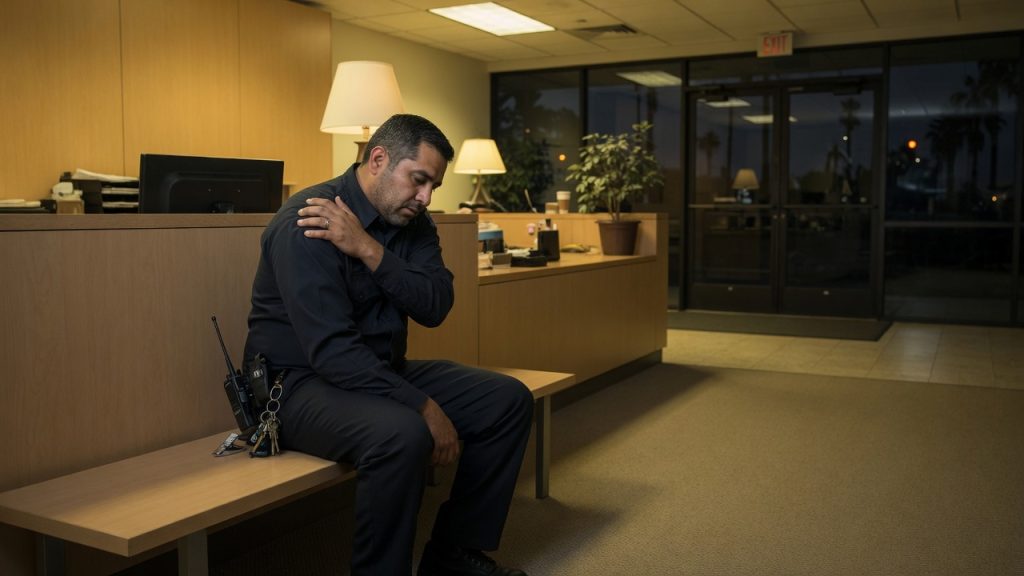
Yes. If you got hurt working security in California, you can usually receive workers’ compensation. That includes medical care and a portion of your lost wages, even if the fall, the assault, or the long shift was not something you could have prevented. Contract guards, in-house officers, and a lot of lobby and patrol posts are covered when you are an employee. You do not have to prove the company was careless. You do have to report the injury and file on time. A guard card does not replace the claim. A contract that says you are an independent contractor does not automatically kill it either.
People finish the shift because the post cannot be empty. Then the shoulder does not come back down. An injury that started when someone shoved you at the door can still be a work injury.
Laguna Law Firm has spent more than 20 years helping injured workers across California. For a straight answer, call (949) 930-1386 or visit lagunalawfirm.com. The consultation is free.
The short version of how this works
California’s workers’ compensation system is no-fault. The insurance company is supposed to pay for a work injury without a fight over whether you should have stepped left instead of right. In exchange, you generally cannot sue the security company for pain and suffering the way you might sue a stranger after a car crash.
You can be hurt in one moment. A pursuit. A fall on wet lobby tile. A punch, a shove, or a door that closes on a hand. You can also be hurt slowly. Feet, knees, and backs wear out from standing a post for years. California treats that cumulative trauma as a work injury too.
Coverage generally starts day one. It does not matter if the site is new to you or the shift was a fill-in.
Who is actually covered?
Contract security employees. If a guard company assigns the site, the uniform, and the schedule, you are in the workers’ compensation world. The name on the building is often the client. The name on the paycheck is often the employer. Write down both.
In-house security. Some hotels, warehouses, and offices employ their own officers. That claim runs against the employer’s policy, the same way any other employee’s claim does.
Unarmed and armed posts. The type of post changes the risk. It does not change the basic rule: an employee hurt on the job can have a claim. Armed or unarmed, report the injury.
1099 and “you have your own guard card, so you are a business.” A Bureau of Security and Investigative Services guard card means you met a licensing rule. It does not, by itself, make you an independent contractor. If the company set the post, the hours, and the right to pull you off the site, bring those facts. Our misclassification article covers the test in more detail.
Two employers. A staffing firm plus a security company, or a security company plus a client that directs your work hour by hour, can create a dual-employment question. Do not guess which policy is the right one before someone looks at the schedule.
Undocumented workers. California workers’ compensation does not require U.S. citizenship for employees. Security licensing is a separate issue. If you were working and you got hurt, say so on the first call so we are careful with what gets shared.
What kinds of security injuries actually qualify?
Almost any injury that arises out of the job and happens while you are doing the job.
- Assaults, bites, and strikes at a door, a lot, or a patrol stop
- Falls on wet floors, stairs, and dark lots
- Shoulder, hand, and knee injuries from doors, fights, and foot pursuits
- Back and foot injuries from years of standing and walking a post
- Vehicle crashes during a mobile patrol
- Heat illness on an outdoor post
- Hearing and stress injuries in the right medical facts
A physical injury from an assault is a regular workers’ compensation claim. You do not have to win a criminal case first. You do not have to prove you fought “correctly.”
A psychiatric injury is stricter. Nightmares, panic, and a diagnosis that needs treatment can be covered, but Labor Code section 3208.3 sets extra rules. Most psychiatric claims require that you worked for the employer at least six months, unless the injury was caused by a sudden and extraordinary employment condition. A violent event is often the fact people use for that exception. The law also asks whether work was the predominant cause, or, for a violent act, a substantial cause. Those are medical and legal questions. Do not decide you have “no psych claim” because a supervisor said guards are supposed to handle stress. Get the diagnosis in a chart, and get advice before you describe the night in a recorded statement.
If the injury is mainly heat on an outdoor post, our heat-illness article is the closer read. This page is about the security job.
The security wrinkle: the client, the report, and the video
The building’s camera is evidence. Ask, in writing, that the incident video be saved. Security footage gets taped over. A written request the same day is more useful than a memory a month later. Write down badge numbers, the time, and who you radioed.
The client is not always off the hook. Your employer’s workers’ compensation claim is the first track. The person who assaulted you, or a property owner who ignored a broken stair or a known threat, can be a second case. Those civil cases have different deadlines and can include pain and suffering. You can have both. Do not sign a statement for the client’s risk manager that gives the second claim away because you want to keep the post.
Incident reports are not medical reports. A neat report that says “employee uninjured, resumed post” can be used against you if your shoulder is wrecked the next morning. Tell the truth in the report. If you are hurt, say you are hurt. If they write the report for you, read it before you sign.
“Finish the shift” is not treatment. You can be professional and still go to an ER or urgent care the same night. Tell the doctor it happened at work and name the security company, not only the building.
What workers’ compensation actually pays
Medical treatment. Doctor visits, imaging, physical therapy, surgery, prescriptions, and mileage. Authorized care for the work injury should not come out of your pocket. Mental health treatment can be part of the claim when a psychiatric injury qualifies.
Temporary disability (TD). If you cannot work, or you can only work reduced hours, you may get wage replacement. In California that is generally two-thirds of your average weekly earnings, subject to state minimums and maximums. For injuries on or after January 1, 2026, the Division of Workers’ Compensation set the minimum weekly temporary total disability rate at $264.61 and the maximum at $1,764.11. The rate follows the date of injury. Overnight differentials and overtime belong in that number if they were real earnings. There is usually a short waiting period, often three days, unless you are hospitalized or off long enough for it to be waived.
Permanent disability (PD). If the injury leaves lasting limits, you may receive a permanent disability award based on a medical rating. A post that requires standing, stairs, and the chance of another confrontation is not a desk job. The rating should say so.
Supplemental Job Displacement Benefit. If you cannot go back to your old job and the employer does not offer qualifying alternative work, you may get a voucher for retraining. In many cases that voucher is up to $6,000.
Death benefits. If a worker dies from a work injury, dependents may have a claim. Security work has those cases. Report them. Do not let a company call a death “off duty” before the facts are written down.
What to do in the first 48 hours
- Get medical care. ER after an assault, a head strike, or a fall. Tell them it happened at work.
- Tell your supervisor and, if the post requires it, the client contact. Same shift if you can.
- Write it down yourself: time, place, what happened, who you told, whether video exists.
- Ask for the DWC-1 claim form. Fill out the employee section. Keep a copy.
- List witnesses. Other guards, a receptionist, a tenant. First names and phone numbers are enough to start.
- Photograph injuries and the scene if it is safe and you are allowed to. Do not pick a fight with a client over a photo.
- Be careful with a recorded statement to an insurance adjuster or the client’s investigator. You can be polite and still say you want to talk to a lawyer first.
California Labor Code section 5400 says you should notify your employer within 30 days. Written notice is what you can prove. Once the DWC-1 is filed, the claims administrator generally has 90 days to accept or deny under Labor Code section 5402. If the claim is denied or ignored, the backstop is usually one year to file at the Workers’ Compensation Appeals Board under Labor Code section 5405.
See our top 10 tips for injured workers in California and, if the file stalls, what to do when a claim is delayed. If the post disappears after you report the injury, look at Labor Code 132a.
How Laguna Law Firm helps injured security guards
We are a California workers’ compensation firm. What that looks like: we separate the guard company from the building, we keep the video request in the file, we treat an assault as a medical claim and not a lecture about “the job,” and we look at a third-party case only when the facts support one.
A California workers’ compensation attorney is typically paid on a contingency fee set by the Workers’ Compensation Appeals Board. You do not write a big retainer check to get started. If there is no recovery, the attorney fee generally is not owed. We will explain the fee in plain English on the first call.
Call (949) 930-1386. Or go to lagunalawfirm.com and send a note. Bring the incident report if you have it.
Frequently asked questions
I went back to the post the same night. Did I ruin the claim?
No. Finishing a shift does not erase an injury. It does make the medical record matter. Get seen, and tell the doctor what still hurts.
The company says assaults are part of the job, so there is no claim.
Dangerous work is still work. The no-fault system exists for injuries that happen because you were there doing the job.
Can I claim stress without a physical injury?
Sometimes. The psychiatric rules are tighter than the rules for a broken hand. A sudden violent event is a different conversation from general job stress. Bring the facts before you rely on either answer.
The client banned me from the site after I reported the injury.
Write down who said it and when. Losing the post can be a workers’ compensation problem and a retaliation problem. It can also just be the client being the client. We sort that from the texts.
I work for an app or a one-off event staffer.
Bring the offer, the uniform rules, and who could fire you that night. The label on the payment app is not the whole test.
Bottom line
A security guard hurt on the job in California can receive workers’ compensation. The injury can be an assault, a fall, or a body that wore out on a standing post. The employer can be the guard company or the building. The claim can still be real.
The hard part is the video, the incident report that says you were fine, and the psychiatric rules if the injury is in your head as well as your shoulder. That is the part we handle.
Laguna Law Firm
Phone: (949) 930-1386
Web: lagunalawfirm.com
Free case review. You talk, we listen, then we tell you what we think. No pressure routine, no mystery bill.