
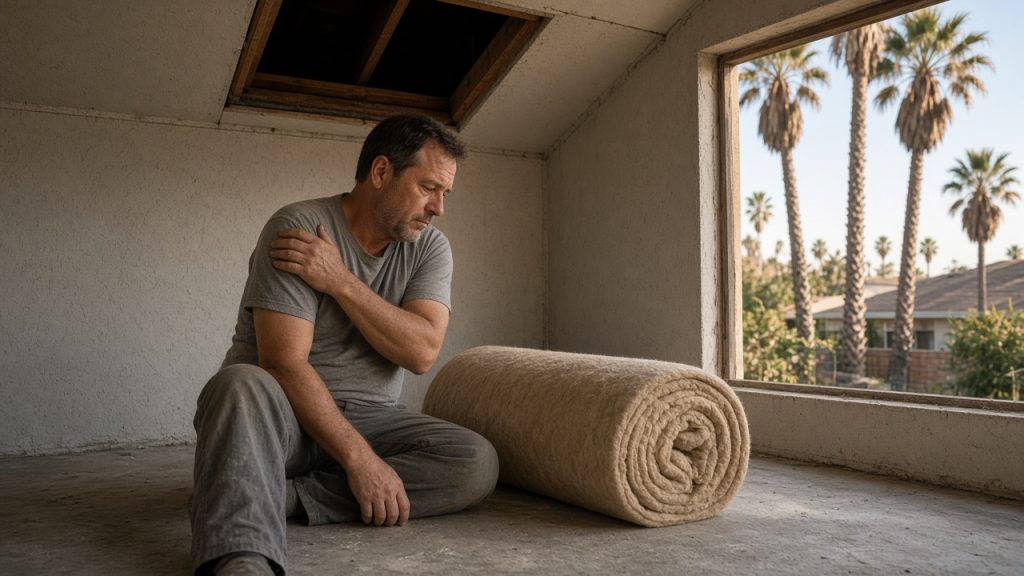
Yes. If you got hurt doing asbestos abatement in California, you can usually receive workers’ compensation when you are an employee. That includes medical care and a portion of your lost wages, even if the strain, the fall, or the exposure was an accident. Containment crews, removal crews, and the people who bag and haul the material are covered when the company controls the work. You do not have to prove the contractor was careless. You do not have to prove you were the person who set the containment up wrong. You do have to report the injury, get medical care, and file the claim on time. A 1099, a day rate, or the sentence “you knew this job had asbestos” does not automatically end the claim.
People finish the containment because the demolition crew is waiting. Then the shoulder does not come back on the drive home. A fall in a suit, or a lung disease a doctor later ties to years of this work, can still be a work injury.
Laguna Law Firm has spent more than 20 years helping injured workers across California. For a straight answer, call (949) 930-1386 or visit lagunalawfirm.com. The consultation is free.
The short version of how this works
California’s workers’ compensation system is no-fault. The insurance company is supposed to pay for a work injury without a courtroom fight over who taped the plastic. In exchange, you generally cannot sue the abatement company for pain and suffering the way you might after a car crash.
You can be hurt in one moment. A fall. A lift. A tear in a suit during the shift. You can also be hurt slowly. California treats both as work injuries. A back or a knee worn out by years of suited work is still a work injury. So is an illness the medicine ties to asbestos. Those slower injuries are called cumulative trauma, or occupational disease. Asbestos disease can take many years to show up. The delay does not, by itself, end the claim.
Coverage generally starts day one for employees. It does not matter if you are paid by the day, by the job, or “just helping this containment.”
Who is actually covered?
Abatement workers. If the company sends you to the address, sets the containment, and can pull you off the job, you look like an employee. A W-2 makes it simple. The claim can still exist when pay is a day rate or cash.
Helpers and haul crews. People who set plastic, bag material, and run the waste get hurt too. The claim does not shrink because you were not the person on the scraper.
The C-22 license and the DOSH registration. Asbestos abatement contractors are licensed in the C-22 classification. The Contractors State License Board describes that work as containment, encapsulation, removal, and disposal of asbestos-containing construction materials. The material is defined in Labor Code section 6501.8. The work is supposed to follow the Division of Occupational Safety and Health, called DOSH. Labor Code section 6501.5 is the registration statute. CSLB does not issue the C-22 classification unless the contractor is registered with DOSH or has a registration application in process, and the training sits in Title 8, section 1529 of the California Code of Regulations. A C-22 license, by itself, is not proof that you are an independent contractor. If the company set the containment and the schedule, bring those facts.
The license is supposed to carry insurance. Business and Professions Code section 7125 requires a C-22 licensee to carry workers’ compensation even when the contractor says there are no employees. If there is no policy, write that down. The injury does not disappear. A claim against an uninsured employer can go through the state’s Uninsured Employers Benefits Trust Fund. That path has its own paperwork. Do not assume you have no claim because the boss said he was a one-man license.
The 100-square-foot line is a registration rule, not a claim rule. DOSH registration is aimed at asbestos-related work involving 100 square feet or more of asbestos-containing material. A smaller disturbance can still be a work injury. Write down what you actually did.
This license does not rebuild the building. The C-22 classification does not include additions, alterations, repairs, or rehabilitation of the parts of the building that stay. Hazardous-substance cleanup, as a separate certification, is not this classification either. If you were doing both, say so. The injury claim follows the work and the employer.
Unlicensed crews on licensed work. California generally requires a contractor’s license when the job is $1,000 or more in labor and materials. Assembly Bill 2622 set that small-job line at $1,000 starting January 1, 2025. Labor Code section 2750.5 treats a worker doing licensed work without a valid license as an employee, and a valid license is a condition of independent-contractor status for that work. Our misclassification article is the longer version.
Two names on one containment. A general contractor, an abatement sub, and a labor outfit can all show up on one address. Write down every name on the invoice, the suit, and the text that sent you the job.
Undocumented workers. California workers’ compensation does not require U.S. citizenship. If you were working and you got hurt, you can still have a claim. There is a longer note in our guide for undocumented workers.
If you are not sure which bucket you fall into, bring the schedule and a pay record.
What kinds of abatement injuries actually qualify?
Almost any injury that arises out of the job and happens in the course of the job. In a containment, that means:
- Falls on plastic, from ladders, and from scaffolds while suited
- Back, shoulder, and knee injuries from scraping, bagging, and years of the work
- Heat illness inside a suit and a closed room
- Skin and eye injuries from the job
- Breathing problems the medicine ties to asbestos or to the other dust on the job
- Illness that shows up years later, when a doctor ties it to this work
- A crash while you are riding in the company truck between jobs
Tell the doctor you did asbestos abatement, what years you did it, and what material you removed if you know. Pipe insulation, floor tile, popcorn ceiling, and roofing mastics are different facts. A photo of the waste label is useful if you safely have one. Do not re-enter a containment for the picture.
For a slow illness, Labor Code section 5412 often sets the workers’ compensation date of injury as the date you first had disability and knew, or should have known, the work caused it. That date can be years after the last containment. Report it when you know. The longer note on chemical exposure is in our chemical-exposure article.
Psychiatric claims have extra rules. A lung disease with a chart note does not.
A lot of people wait because the shift felt like heat and a sore back. Then a doctor names the dust. If a foreman told you to stay in the containment after you reported a tear in the suit, trouble breathing, or a fall, write down the date, the name, and what they said.
Heat inside a suit is still a work injury. The longer note is in our heat-illness article. If the injury is mainly a fall, our slip-and-fall article goes further on that pattern. This page is about abatement work.
The drive from your house to the job in your own car is usually a commute. Riding in the company truck between containments is a different fact. Our going-and-coming article is the longer version. Our work-related car accident article covers the crash pattern in more detail.
The containment wrinkle: the slow disease and the other lawsuit
Knowing the job had asbestos is not a defense. That is the work. You do not lose the claim because you were hired to remove it.
A day rate belongs in the wage math when it was real. Bring the texts and what you deposited. Years of day rates can matter when the illness shows up later. Write down the employers you can remember, the years, and the kind of material.
The workers’ compensation clock and the lawsuit clock are different. The claim against your employer is the workers’ compensation claim. A civil lawsuit against a company that made or supplied the asbestos product is a separate case. Code of Civil Procedure section 340.2 gives that lawsuit a short deadline: the later of one year after you first had a disability, or one year after you knew or should have known the disability was caused by the exposure. In that statute, disability means time off work that keeps you from your regular occupation. Wrongful death claims based on asbestos exposure have their own one-year rule in the same section. Do not wait for the workers’ compensation file to finish before you ask about the lawsuit. Do not sign a release that gives one of the cases away.
You generally cannot sue your employer for pain and suffering. That is the trade-off of the no-fault system. The product company is a different defendant, and only when the facts support it.
Your health insurance is not a substitute. You should not have to run a work injury through a personal plan because the company does not want a claim.
What workers’ compensation actually pays
Medical treatment. Doctor visits, imaging, breathing tests, surgery, prescriptions, and mileage to appointments. Authorized care for the work injury should not come out of your pocket.
Temporary disability (TD). If you cannot work, or you can only work reduced hours, you may get wage replacement. In California that is generally two-thirds of your average weekly earnings, subject to state minimums and maximums. For injuries on or after January 1, 2026, the Division of Workers’ Compensation set the minimum weekly temporary total disability rate at $264.61 and the maximum at $1,764.11. The rate follows the date of injury. A day rate, if it was real earnings, belongs in that number. There is usually a short waiting period, often three days, unless you are hospitalized or off long enough for it to be waived. Many claims also face a time cap, often 104 weeks within a five-year window, with exceptions for some severe injuries.
Permanent disability (PD). If the injury leaves lasting limits, you may receive a permanent disability award based on a medical rating. Abatement work is not a desk job. The rating should reflect what the medicine actually found.
Supplemental Job Displacement Benefit. If you cannot go back to your old job and the employer does not offer qualifying alternative work, you may get a voucher for retraining. In many cases that voucher is up to $6,000. It is not automatic. Bring the offer in writing before you turn it down.
Death benefits. If a worker dies from a work injury, dependents may have a claim. An asbestos death can raise that question years after the work. The civil deadline above is a separate clock.
What to do in the first 48 hours
- Get medical care. ER if you cannot breathe, you fell, or you had a heat emergency in the suit. For a disease found years later, see a doctor and tell them about the abatement work. Tell them it was work.
- Tell the foreman or the owner, the same day if you can. If the diagnosis came years later, notify the employers you can identify, in writing.
- Follow up in writing. Text or email with the date, the body part or the diagnosis, and the job.
- Ask for the DWC-1 claim form. Fill out the employee section. Keep a copy.
- Write down who saw it, what material you removed, the years you did the work, and every company name.
- Keep any waste labels, pay records, and training cards you already have. Do not re-enter a containment to look for them.
- Be careful with recorded statements to an insurance adjuster, and with any paper that releases a product company. You can be polite and still say you want to talk to a lawyer first.
California Labor Code section 5400 says you should notify your employer within 30 days. Verbal notice can count. Written notice is what you can prove. For a disease you just learned about, report it now, in writing, even if the exposure was years ago.
Once the DWC-1 is filed, the claims administrator generally has 90 days to accept or deny under Labor Code section 5402. If they do not deny in time, the injury can be presumed compensable. While they investigate, they are supposed to authorize medical treatment up to a statutory cap.
If the carrier says no, or the file stalls, the backstop is usually one year to start a case at the Workers’ Compensation Appeals Board under Labor Code section 5405. Occupational disease claims often run from the date you first had disability and knew, or should have known, the work was causing it. That rule is Labor Code section 5412. The civil asbestos deadline in Code of Civil Procedure section 340.2 can be one year. Do not wait on that one.
For a longer punch list, see our top 10 tips for injured workers in California. If the employer or the insurer is sitting on the file, read what to do when a claim is delayed. If the next job disappears after you report the injury, look at Labor Code 132a retaliation protections.
How Laguna Law Firm helps injured abatement workers
We are a California workers’ compensation firm. We help people who did this work get medical care authorized and benefits paid.
What that looks like: we review what you told the foreman or the doctor, we sort the contractors on the job, we build the wage picture from the records that still exist, we file what still needs filing, and we fight treatment delays. We look at a product case only when the facts support one, and we treat that deadline as its own clock.
A California workers’ compensation attorney is typically paid on a contingency fee set by the Workers’ Compensation Appeals Board. You do not write a big retainer check to get started. If there is no recovery, the attorney fee generally is not owed. A civil case has its own fee agreement. We will explain the fee in plain English on the first call.
Call (949) 930-1386. Or go to lagunalawfirm.com and send a note. Virtual consults are available. Bring the schedule, a pay record, and the diagnosis if you have one.
Frequently asked questions
I am paid by the day and I get a 1099. Am I covered?
Maybe. A 1099 does not decide it. If the company sent you to the containment and set the work, bring those facts.
The doctor just connected my lungs to work I did years ago.
That can be an occupational disease. The workers’ compensation date is often the date you first had disability and knew the work was causing it. Report it now. Ask about the civil deadline in the same conversation.
The boss said he has a C-22 and no employees, so there is no insurance.
A C-22 license is supposed to carry workers’ compensation even in that situation. Write down the license name. The injury can still be a claim.
I only bagged the material. I did not scrape it.
Bagging, hauling, and setting plastic are still the job. Say what you did and for how long.
Can I pick my own doctor?
It depends on whether there is a valid Medical Provider Network and where you are in the process. Ask before you sign whatever the company hands you.
Can I sue the company that made the old pipe insulation?
Sometimes. That is a civil case, separate from the claim against your employer, and Code of Civil Procedure section 340.2 can give it a one-year deadline. Talk to a lawyer before you sign anything.
Bottom line
An asbestos abatement worker hurt on the job in California can receive workers’ compensation. The day can be a containment this week or a diagnosis years after the last job. The claim can still be real.
The hard part is the day rate, the employer who says the license has no employees, and a civil deadline that does not wait for the workers’ compensation file. That is the part we handle.
Laguna Law Firm
Phone: (949) 930-1386
Web: lagunalawfirm.com
Free case review. You talk, we listen, then we tell you what we think. No pressure routine, no mystery bill.